

Tribal communities honor Truth in History for Indigenous People’s Day on Alcatraz
By shaylyn martos
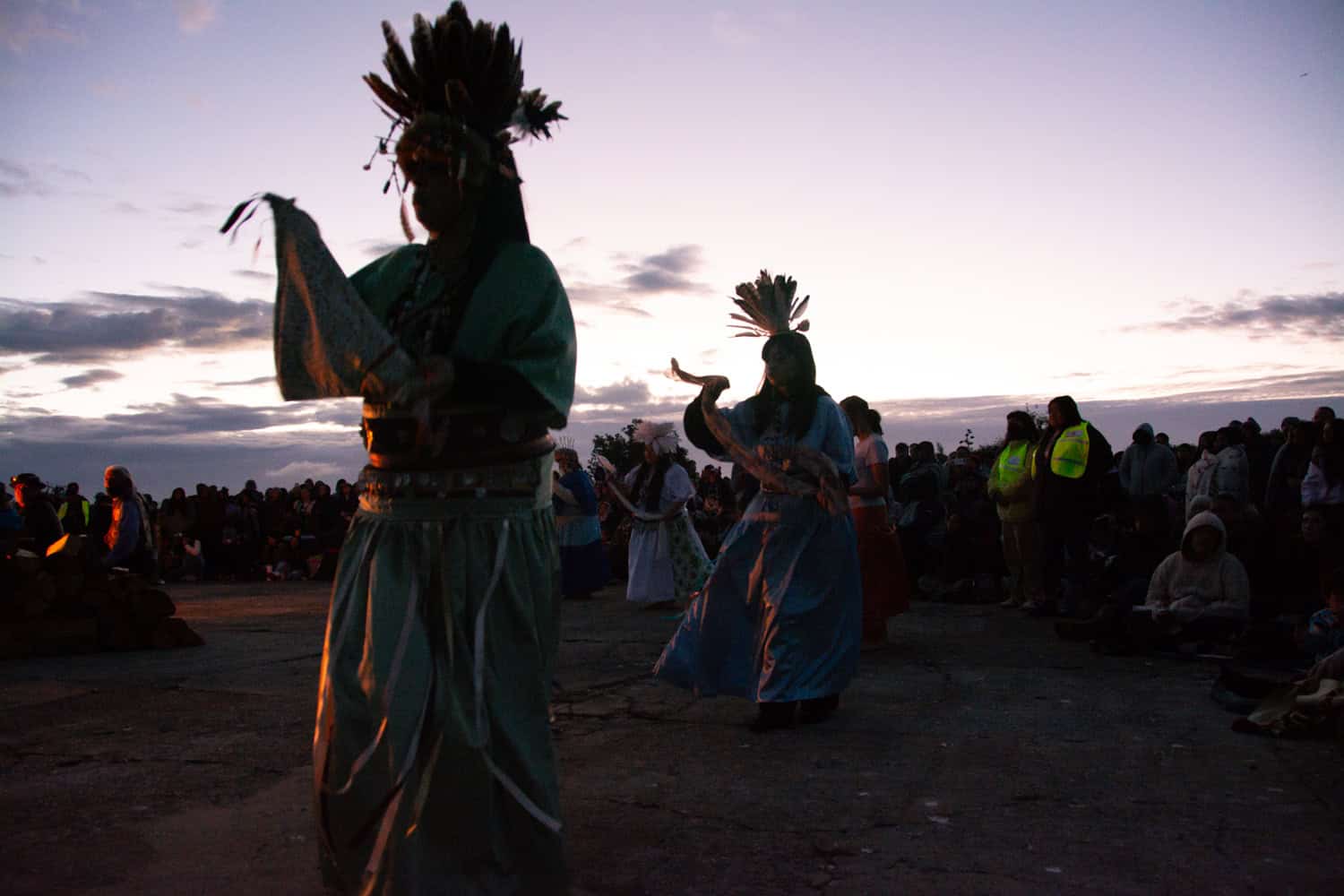
At 4:30 in the morning, tribal peoples from across the nation marched to the parade ground on Alcatraz Island to celebrate Indigenous People’s Day. Drummers and Native youth holding flags of different nations led the way. It was cold, so people grouped together to stay warm, and the path was illuminated by warm bulbs and phone flashlights.
Radley Davis: We are here to honor Truth In History. The International Indian Treaty Council honors those who occupied this island in 1969, who called attention to the injustices Indigenous peoples are facing. They woke up the world to our struggles and our existence and lit the spark that launched our movement and took us all the way to the United Nations.
Dancers, elders, organizers, and allies celebrated the original 19-month occupation of Alcatraz from 1969 to 1971. They also honored the Indigenous resistors who were imprisoned on Alcatraz, the Hopi and Modoc peoples who fought against American occupation.
As relatives disembarked from the ferries and made their way to the parade ground, the fire in the middle of the circle was stoked and maintained. Around the circle were chairs for elders and folks with disabilities, and a microphone was situated nearby the youth holding flags.
Morning Star Gali (kac Ajumawi band of Pit River) is the California Tribal Liaison for the International Indian Treaty Council and the Executive Director of Indigenous Justice.
Morning Star Gali: We still have many of our relatives, our aunties, our uncles, our educators that participated in that occupation, that are here on the island this morning. We are here for Indigenous People’s Day, which is significant in terms of celebrating the resistance, the ongoing resistance of Indigenous peoples.
Gali said this year’s celebration was complicated by the ongoing government shutdown. Organizers worked to ensure that despite the issues in the federal government, people could still come to honor the sunrise. She thanked the IITC’s Rochelle Diver in particular for her work to secure the permits needed to hold the ceremony.
Morning Star Gali: In past years, when there’s been shutdowns, we have not been able to hold the gathering. But in light of what is happening with this current administration, National Park Service and Alcatraz Cruises, the ferry boat operators, understand the importance and significance of today. We are gathered under our First Amendment right. And so we are here to gather today in prayer, in celebration and recognition of Indigenous peoples here locally and around the world.
President Trump says he has plans to reopen Alcatraz as a prison specifically for ICE detainees. But the island is unfit to house any incarcerated people. There’s currently a $62 million rehabilitation effort to correct seismic structural deficiencies, and whole areas are fenced off with signs warning “Danger.” From the parade ground facing west, the warden’s house and the lighthouse look like ruins. Because of the shutdown, the Department of the Interior was unable to provide comment.
Native people began honoring the sunrise at Alcatraz in 1979, when Bill Wahpepah organized the first sunrise ceremony west of the Mississippi. Today, the Sunrise Ceremony also gives organizers the opportunity to inform relatives about their struggles and accomplishments over the past year.
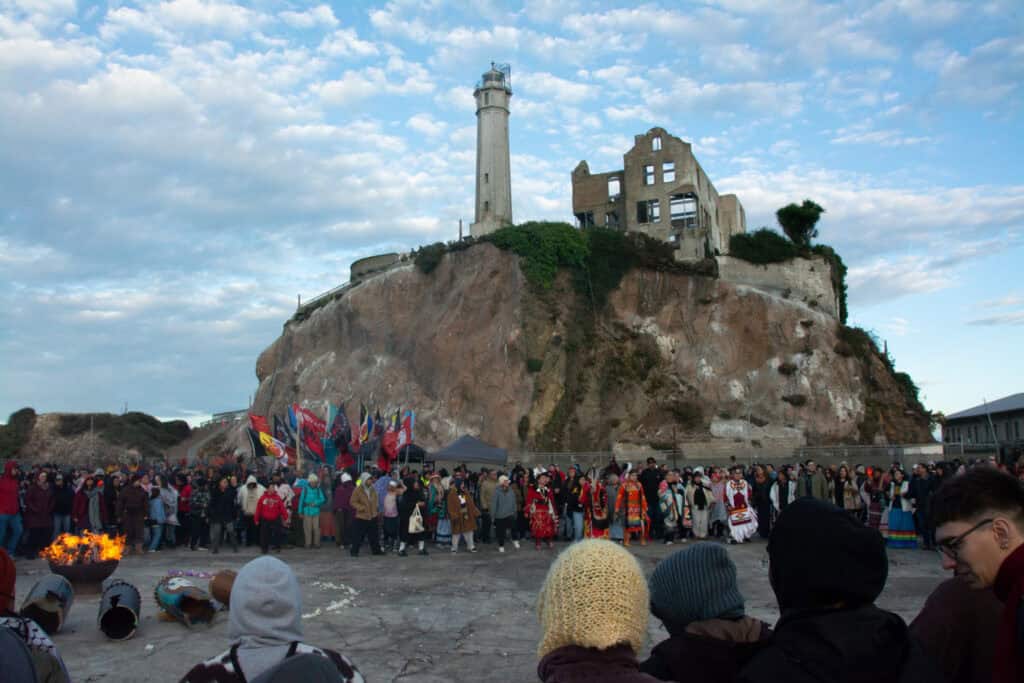
Community members join in a round dance during the sunrise ceremony on Alcatraz Island. (Photo by shaylyn martos)
Crystal Wahpepah, founder of Wahpepah’s Kitchen, announced the name of her upcoming cookbook, A Feather and a Fork: 125 Intertribal Dishes from an Indigenous Food Warrior. She shared how her journey as an Indigenous chef started from seeing the food insecurity native people face when she was young.
Crystal Wahpepah: The seed was planted in me, pretty much at the age seven, where I seen the absence where it comes into our foods that we didn’t have. It is a human right for us to have these foods. When I travel all through the world, all through Turtle Island, I see so many beautiful foods. And so this is one of the reasons why I call myself an Indigenous chef. Because I started off in community. I feed community, and it’s about community.
Relatives were invited to take the mic and share their music. And as elders speak, dancers came through the circle to sweep the ground. Gabriela Flores Romo (Mexica) is the captain of the UC Davis Calpulli Huitzilin dance troop. She danced with the other Mexica tribal people that honored the sun deity as it rose. Because the dance is a religious practice, community members were asked to not take any photos.
Gabriela Flores Romo: It’s prayer and standing in solidarity with all our Indigenous people, because today we’re reclaiming the day as Indigenous People’s Day. We’re seeing Huītzilōpōchtli every day, rise again. And basically, he’s a testament of our ancestors, just seeing the sun rise again. I just really love being here with different Indigenous people here and learning their stories.
The dancers asked all those in attendance to face the sun as it rose and express gratitude. As relatives packed and prepared to take the ferries back to San Francisco, they were encouraged to make tobacco offerings in the fire.

Casey Camp Horinek (Ponca Nation) celebrated her first Alcatraz Sunrise Ceremony with her grandson and her nieces. She came in part to honor her brother Craig Camp, who was an original occupier of Alcatraz Island in 1969.
Casey Camp Horinek: I think that it’s always important for Indigenous people to gather, because when we gather, the strength multiplies exponentially. I love resistance to the status quo, particularly when we’re living under a right wing regime that is trying to destroy us.
Manny Lieras (Navajo, Comanche) and his daughter Joni Marshall-Lieras (Navajo, Comanche, Eastern Shoshone, Shoshone Bannock) are members of the All Nations Singers and Dancers based in Oakland.
Manny Lieras: I’ve been in the Bay Area 21 years, 22 years, and I haven’t missed it like since I moved up here. Now I have my own family, and so being able to bring my daughters out here and my wife to come and dance and to sing is a blessing.
Reporter: Do you have any tips for anybody who wants to come for their first time?
Joni Marshall-Lieras: Wear warm clothes! Wear lots of warm clothes, and make sure you have food and energy and like water and just like, a good mindset and a good attitude and like, yeah, just be prepared for the coldness.
This story was produced in partnership with KALW. Check out the audio version of this story on their website. shaylyn martos is a California Local News Fellow with the UC Berkeley Graduate School of Journalism.
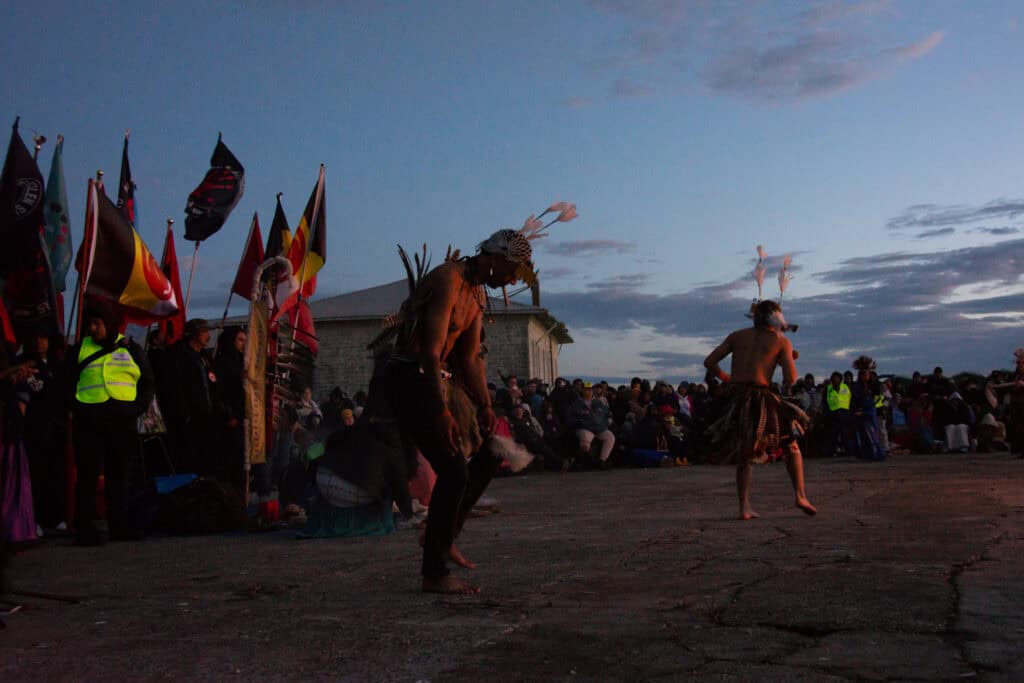
Yuki Resistance dancers as the sun rises on Alcatraz Island for Indigenous People’s Day. (Photo by shaylyn martos)