Animal pet care in California tribal communities: An interview with Yurok Veterinary Assistant Damien Scott
By Terria Smith
A lot of us have heard of (or have had) “rez dogs.” If you come from tribal reservation communities, you have surely heard this term used to describe our scrappy little furry friends that roam around, getting into misadventures. Although we often characterize rez dogs as being tough, the truth is that they are a vulnerable population that needs a lot of support from their human allies.
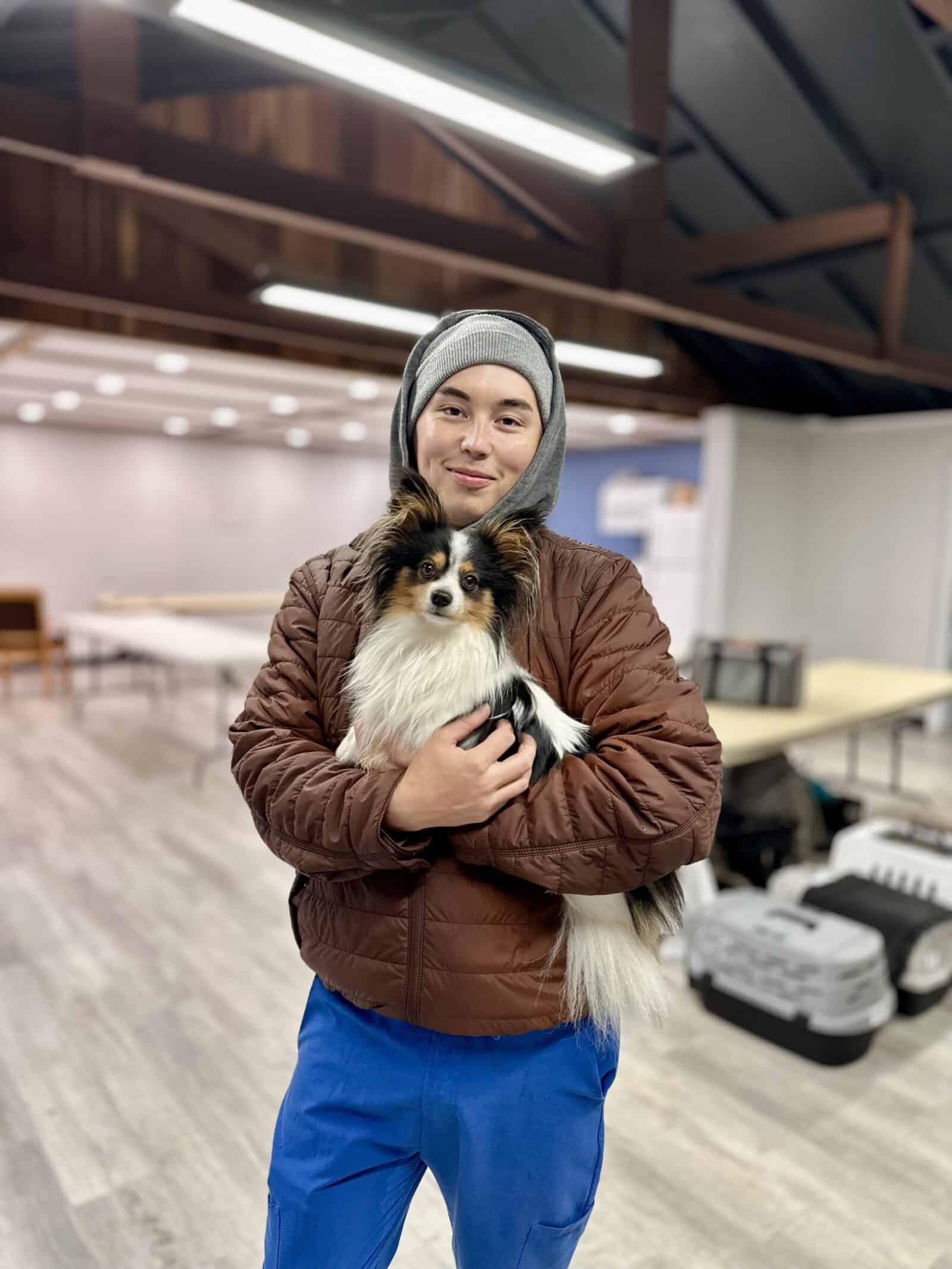
To address some of the needs of our reservation pets, News from Native California took the time to talk with Damien Scott (Yurok/Tolowa/Karuk descendant), who previously volunteered in the animal welfare field but now works as a veterinary assistant in underserved communities. He shared what he has and is currently experiencing on reservations in Northern California.
Terria Smith:
Just now. Okay. So, tell me about how you’ve gotten into all of this stuff with caring for the little animals on the reservation.
Damien Scott:
So, I grew up in Hoopa. It’s a small reservation up north. It’s about five hours north of Sacramento. We are a one gas station, one store small town, and we don’t have a lot of resources there. We don’t have animal control. Our police for a long time did not have laws to enforce for animal welfare and stuff like that. I started rescuing animals when I was in high school. I was getting to my senior year and then I volunteered with Public Vet, we kind of started building a relationship from there then I kind of stepped away a little bit from them and I just did animal rescue for a few years, and then I reunited with them, and I’ve been working with them ever since. Working on spay and neuter. I think rescue is great, but I do think that you can only rescue so many animals. The bigger more beneficial thing is to spay and neuter so I’ve kind of stepped away from animal rescue now and more into the Spay and neuter realm, trying to organize that stuff and help in that way. But, yeah, I started rescuing in high school and it just trickled on from there.
TS:
Okay. Can you talk a little bit about what that looks like? I know what the dog situation is on my reservation, but can you talk a little bit about what it looks like there in Hoopa?
DS:
Yeah, so when I first started, there were some people who were working in animal rescue a little bit here and there, Denise and Kathy Hoefacker are amazing ladies. They did a lot before they stepped away. When I first started there was a lot of stray animals running downtown. We used to have packs of dogs downtown, like 10, 12 dogs strong with puppies and it was pretty crazy. There was a lot of strays and a lot of packs of dogs running. I feel like now we’ve done a lot of work in the Spay and neuter area, rehoming, rescuing and stuff like that so you don’t see that as much anymore. It’s more in the secluded areas that you see the packs of dogs now. It’s tucked away on properties and tucked away in the back away from the highway so they’re not as visible, but the problem is still very prominent there.
TS:
Okay. All right. Thank you so much. And have you found that other communities that have the same sort of issues, same sort of problems just in your experience?
DS:
Yeah. I grew up in Hoopa but I’m Yurok, Karuk and Tolowa, the Yurok reservation and the Karuk reservations are all side by side right there. We all have very similar problems. I also have friends who live in Covelo and they have similar problems as well. The Tolowa reservation is not as bad because they’re less remote, so they have less rural area and more access to vet care on both ends. They have Crescent City and Brookings, so they have more vet care resources there, as opposed to us that are in the remote areas of Humboldt where most towns don’t have a vet within an hour so vet care is very limited.
TS:
Okay, very good. So today, what does it look like, the vet and animal care and everything, and what kind of work are you able to do? And what kind of challenges do you still need support with?
DS:
So today we still lack vet care very heavily. We did get a new vet that is in Willow Creek, which is about 15 minutes from Hoopa. They’re great, but they charge regular veterinary prices, which for most people, especially on the reservation is not realistic. People on the reservation most of the time are not financially able to pay big vet bills so our biggest challenges that we face are financial issues, lack of access to resources for help with
animal care and education. Luckily the organization I work for has grant funding so we’re able to subsidize people’s spay and neuter services with that grant funding. Finances are probably our biggest challenge, and then second would be lack of education on vet care;
what spay/neutering does for your pet and how many animals your pet can have over a year if they are not altered. So, education is a big barrier as well.
TS:
I had a question specifically about education. Do a lot of people come to the Spay neuter clinics and everything like that? Do you find that it’s accessible to people, or do you find that people would rather just, I don’t know, somebody had said, “Why not just let the dogs roam free”; type thing?
DS:
So, it varies a lot. When we first started, we had a massive turn-out every time. We would have huge lines all the way down the road because we do a drive-through style. So, they drive through, they check in, they drop their pet off, and they come back at night. We would have 60, 70 plus animals a day for three days in a row. Public Vet has been coming to our community for probably 15+ years. I’ve been working with them for about 10 off and on and 8 solid years. Our clinics are smaller, they’ re much more manageable because I think we’ve been so consistent. Recently we’ve been only going maybe once a month, which has been okay because while there is a huge need, there has not been a huge turnout. So our clinics have pretty steady there. They’re not crazy, but they’re not too small. We’ve also been working towards a more one-health approach with our veterinary care now so we’re trying to include human health and animal health to improve both because there are a lot of diseases that pets have that transfer over to humans and it’s now recently becoming studied. We’re trying to educate people on that aspect of pet ownership and what they can do to prevent that stuff as well. So, they’ve been pretty receptive, our clients who do come. It’s getting a lot better for sure.
TS:
For people who aren’t familiar with Spay and neutering, is it a pretty simple procedure? DS:
Yeah, so for male dogs it’s neutering. The surgery is very minimal. They recover quickly. You do have to leash walk and keep them from chewing at their incisions and stuff like that. But for the most part it’s very minimal, very standard and recovery times are quick. For females, it’s called Spaying and it’s a little more invasive for them, but they still recover very quickly. We always recommend doing them younger because the younger they are,
the less blood supply they have to those organs, and they just heal a lot faster. They just recover so much faster, they bounce back a lot better. Older animals tend to have a harder time. Larger animals have a harder time just because there is so much more stuff being taken out and so much more blood flow to those organs.
TS:
Okay, all right, very good. Can you talk a little bit about some of the ramifications if communities don’t mass Spay and neuter their animals and everything like that? What are some of the problems and stuff that you’ve seen or that can happen?
DS:
So, in our community, we didn’t have Spay and neuter for a long time, or it wasn’t as pushed due to lack of education. Because the people who I work with, Public Vet, aren’t from our community. People in our community are very like, “You’re an outsider, we’re not going to trust you”; While Public Vet is an amazing organization and is full of amazing people, It wasn’t really trusted or pushed and the information wasn’t being taken seriously due to this barrier of distrust or skepticism. As a native person myself, I totally understood where this feeling was coming from. I started working with them and the rescue group that I was with at the time started working with them. We were all local people so we were able to really help get it out into the community and push the idea that this is a good thing and Public Vet is bringing us a valuable resource that is good for our community.
So, it just wasn’t accepted, and people were not coming in. Now that people are accepting the idea, it has been improving a lot. If you do not Spay and neuter your pets, the overpopulation problem grows extremely fast. There’s a lot of wild dogs, there’s a lot of wild cats, and cats are unbelievably bad for the environment. I mean they are great for us, but they do kill a lot of native species. They reproduce extremely fast. There are large populations of them and once they start getting sick, the disease spreads fast throughout those populations. These diseases can quickly jump over to people’s domestic pets that they keep inside or that just go outside once a day; they get infected with a lot of stuff from these other cats that are really sick. Then the stray dogs, they get into garbage and they end up attacking people. They attack a lot of livestock and a lot of other pets. Owned animals end up getting attacked and sometimes killed by these stray dogs \ because there are so many of them in a pack. The biggest thing is overpopulation. It’s a danger to the community. In my community in Hoopa, we’ve had multiple people attacked by stray dogs, and they have had to go to the hospital and get all kinds of crazy surgery. So, it is dangerous to not have Spay and neuter in the community as animal populations grow rapidly.
TS:
Okay, I wanted to ask too, finally, what people can do to support the Public Vet efforts and everything like that. How can they support what you guys are doing?
DS:
The biggest help for us is just spreading information about our clinics and spreading links to the clinics for people to register and people reaching out within their own communities. I now live in Sacramento, and we are trying to expand our reach farther south to assist with reservations that are down this way and even southern California. While we are working to expand farther down in California, we will also keep doing clinics up north. I think that many reservations and communities in general would benefit from our services. We don’t only have to work in Native communities; we just want to help people out. So, wherever we’re wanted, we will come. We just need to have a building and a location to work at. So, our biggest thing is just outreach and having people reach out to us with clinic locations and what needs they have in their communities.
TS:
Okay. Are there websites or links that people can go to find out more information?
DS:
Yeah, so if they look up pub.vet, it is P-U-B dot vet it will pop our website right up and you can look through our bio and stuff like that, and it has links to where we will be in California. We work in California and Indiana, so we are back and forth a lot. It will have clinic locations for both states.
TS:
Very cool. Anything I did not get to ask you about that you really want to make sure that you talk about?
DS:
I just think that it is important to stress that you should really get your cats and dogs spay and neutered.
Spay and neuter is really big for cats. It can lead to a lot of problems, especially with female cats if they are not fixed down the line. They can get all kinds of issues with the reproductive organs if they aren’t reproducing and going into heat back over and over again.
And then we want to focus more on one health now instead of just Spay and neuter and just helping improve the relationship between humans and their animals, letting people know that their animals do carry parasites and diseases that they can catch, and they should be cautious of that, taking all the preventative measures they can to avoid that stuff. Flea treatment is very important because fleas are a pathway for disease and they help transfer a lot of diseases to humans. Ticks also and then worms. They all help transfer disease over, so it is best to be up to date on your vaccines, your dewormer, your flea medication, all that good stuff. Just stay up on your routine stuff and test your pets.
None of this would be possible without all of our wonderful staff at Public Vet, our doctors, Dr Aria and Dr Gabriel as well as amazing director Dr. Peavy. Without her vision and dedication to helping people, Public Vet would have never found its way into native communities.
If you would like to see us in your community, please reach out to me via email (Damien2scott@gmail.com) or text (707-502-9342). We would love to help any communities who want us to come.