

All Together Now 2025
By Tori McConnell
It wasn’t intended to be a spiritual gathering, but it felt like one. It seems like whenever Indigenous women from anywhere come together it’s near guaranteed that the good feelings of unity and ceremony will follow. “All Together Now” is what we embodied at a gathering to honor and uplift the work and accomplishments Indigenous California women on December 6, 2025, and it is the perfect title for the relatively new annual gathering hosted by Indigenous Futures Institute in Kumeyaay lands at UC San Diego.
The evening before, Chag Lowry (Yurok, Maidu, Achumawi) picked me up from the airport with a welcoming vibe. Chag is the Executive Director of Indigenous Futures Institute and a recent recipient of the UCSD School of Public Health’s highest award, the Impact Award. As executive director of IFI, Chag organized the first All Together Now in 2024 and had been putting in the hours to make the 2025 event just as successful. As we sat in a tall wooden booth for dinner at the best Italian restaurant I’ve ever been to, he started to tell me how he loves having guests from the far north. Even if it’s not a close blood relative, seeing a Northern California Native among the city of San Diego brings him a comforting, familial feeling. I knew what he meant.
When you’re a Native living anywhere away from your homelands it’s impactful seeing someone from your tribe wandering around. But even more nuanced is the experience of being an Indigenous person on a University of California campus and getting to see someone that gives you the feeling of home.
Something about the colossal academic buildings and angular concrete structures makes a Native yearn. For Chag and I, the idea hit even closer to “home” knowing that we had lived in the same part of Eureka where both his children and I grew up years apart. He started telling me how that sense of tribal family engendered such a good feeling while hosting Xatímniim Drake, an outstanding young Karuk artist from Orleans, for a prior event called “Indigicon”. As we each worked away at the pasta in front of us we caught up, talked about family and school, reminisced on stories of parents and elders, and let our conversation wander to all the different cool ideas that we could explore through our work. When we had fully caught up and the restaurant emptied out, Chag dropped me off at my hotel for the night. I hung up my black dress and vintage cut multicolor pendleton blazer, set out my elkhorn jewelry and Pordy bracelets, and tried to get some rest in anticipation for my first chance to experience All Together Now.
The day started with the usual trickle of attendees filtering through the doors of the Forum on the upper level of the Price center at UCSD. I had found my seat in the front row next to my new friend and fellow panelist Anah Esquerio after Chag had graciously picked us up for our early ride to campus. Faces both familiar and new greeted me as they walked past the check in table – faces marked with the beauty of traditional chin tattoos, faces framed by Indigenously luxurious earrings, faces of all shapes, sizes, and ages beaming with smiles.
To set the tone for the day, our event moderator Alexis Munoa-Dyer (Pechanga Band of Indians) made way for Priscilla Ortiz (Iipai/Luiseño) to open us up with a blessing. The conference crowd herded ourselves through side doors onto the venue’s balcony. We efficiently formed an ellipse through which smudge in an abalone shell began its rounds while Priscilla gave prayers in both Iipaya, her Indigenous language, as well as English. The way her beautifully crafted, encouraging words flowed effortlessly from her lips impressed me deeply. A former Miss Kumeyaay Nation 2022-2023, Priscilla embodied the perfect blend of poise and humility that every royalty title holder strives for. She pulled together a large group of people from all over California and made us feel all at home. I doubt that there were any negative feelings floating about that morning, but if there were then Priscilla disarmed them effortlessly with her prayers, good attitude, and help from the pure smoke seeping from the sage.
The first panel of the day was built to honor our Kumeyaay hosts, the Indigenous people of the San Diego area. Kumeyaay community members Alexxa Casanova (Kumeyaay), Alison Richardson (Viejas Band of Kumeyaay Indians), Priscilla Ortiz (Kumeyaay from the Iipay Nation of Santa Ysabel and Payomkawichum from the Rincon Band of Luiseno Indians), and Angela Elliott-Santos (Chairwoman, Manzanita Band of the Kumeyaay Nation) sat down in front of the mic to share with us their experiences as Kumeyaay women, what they personally overcame, and how they got here. Alexxa Casanova works at UC San Diego with the Transportation Research and Education for Driving Safety (TREDS) Center on a project to provide traffic safety and education for the Kumeyaay community, specifically addressing the discrepancy between those who are seeking drivers licenses but don’t have experience navigating San Diego’s roads due to being raised on or living on reservations where the roads do not have traffic and pedestrians. This was extremely important, as panel presenter and first woman CEO of California Rural Indian Health Board Virginia Hedrick (Yurok/Karuk) later in the day shared that “motor vehicle incidents” is the number one leading cause of death for American Indian/Alaska Native individuals ages 1-44. As Alexxa recollected her journey to higher education and community work, she brought tears to our eyes as she recalled that as a single mother she was once discouraged from her educational pursuits. Yet, she found strength within herself and reclamation of her identity to challenge intergenerational trauma and achieve what others said she couldn’t.
Passing the mic to Alison Richardson, we heard about her rearing on the Viejas Reservation, and how she too overcame barriers to higher education and is now making strides grant writing and working at a veterinary clinic. As a professional growing rapidly in her career she iterated the power of Kumeyaay presence on the UC campus, recalling a pivotal moment when she first felt feelings of foreignness and culture shock start to dissolve when she noticed her own relative’s work featured as an art installation on campus during her freshman year of undergrad. For Alison it was a sign – a message that she belonged here, yes, but also a deep reassurance that even amongst the concrete campus buildings this was still Kumyaay land. Priscilla, our fearless leader in starting the day, went on to describe how she is deconstructing the trauma of colonization on her family. She centered the influence of her Native language journey and its role in breaking toxic cycles and struggles in order to make a name which her descendants and ancestors can resonate with – a name which her community can turn to as an example of someone who makes a positive impact on multiple fronts. “It’s more than a position or title,” she said. “It’s circular.”
To close the panel, Manzanita Kumeyaay Tribal Chairwoman Angela Elliott-Santos first took a moment to sit for a minute in the feelings of inspiration, pride, strength, and healing that filled the room with the stories shared by the first three young ladies. I wish I could be the first to say that with every pass of the mic, each unique story from each young lady brought tears to my eyes. But I think I was not the only one who was so deeply moved and inspired by their words, and that continued with Chairwoman Angela Elliott-Santos.
“Every single thing we accomplish we have to take it into our own hands,” she began. “In this world we have lost our respect for our Native women. The stealing of children is happening again… if it is happening to others it will happen to us again; if we don’t stop that hate we don’t know where we are going.”
Discernment tells us that both (political) sides are part of this problem, and the chairwoman pressed the strategy of starting to endorse young people in politics. A prudent statement, given the drive, professionalism, and achievements of the young people who set the stage for the Chairwoman’s panel conclusion.
With a little extra time, moderator asked a final question, “What actions do you want to see UCSD take to be in better partnership with Kumeyaay?” In the same order that they began, first starting with Alexa Casanova and going down the line to Alison Richardson, Priscilla Ortiz, and Chairwoman Angela Elliott-Santos, came these responses. 1) Give ancestral remains back. Put Indians in positions where they once were told they don’t belong. Put young leaders in leadership roles wherever they can fit, and support more female chairwomen. 2) While appreciating what UCSD has done so far, continue and expand the work of bringing opportunities into the reservations and rural tribal communities – especially with culturally grounding rehabilitation centers on reservations. 3) Echoing the importance of bringing university resources into reservations and rural tribal communities, we can view colonization through a different lens. If the federal and state governments put so much effort into wiping out the Indigenous population, yet Indigenous communities still live today, then that colonization effort was a failed mission. It begs the question, who was really conquered? 4) There should be a piece of land on the UCSD campus that is dedicated for the use of Kumeyaay people. Additionally, the university should help Kumeyaay high school students gain access to the high school course requirements needed to matriculate into the university – because so many of the high school students that might want to go to a UC don’t even have the necessary prerequisite classes available to them at their high schools. Perhaps if the UC can’t make those prerequisites accessible, they should consider making exceptions for Indigenous students whose high schools literally do not provide those necessary classes. Because how are Kumeyaay students supposed to get an education at UCSD and bring Kumeyaay representation if there are structural barriers to admission?
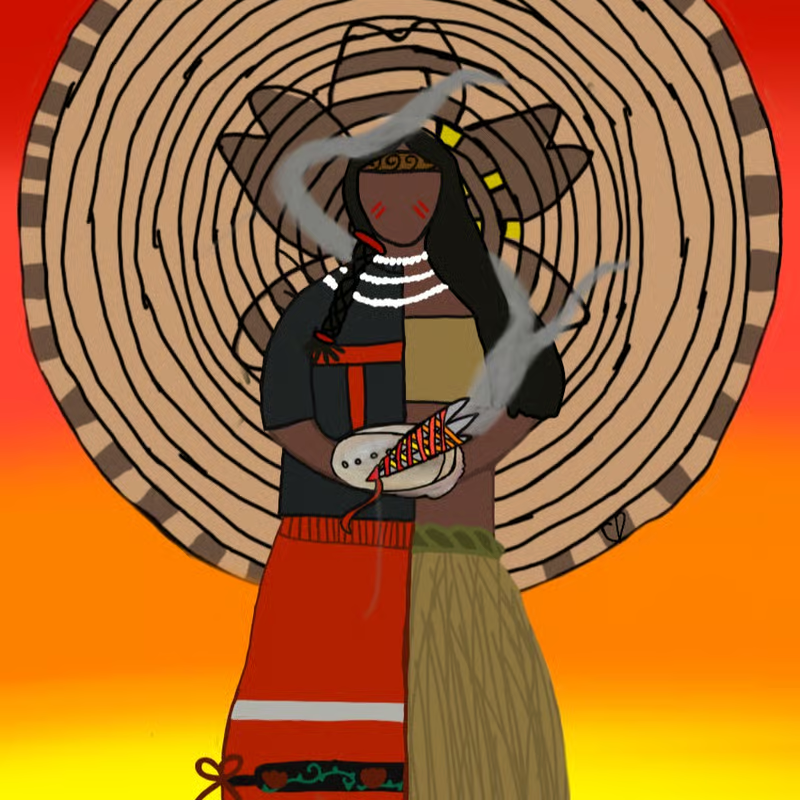
As we all wiped any remaining tears from this outstanding opening panel, University caterers were outside setting up lunch. The last presentation of the morning was announced: honoring the young artist who designed the 2025 flyer, Chamish Duro (Kupa/Tongva/Chumash/Desert Cahuilla). Dr. Cheryl Anderson, Dean of UCSD School of Public Health in which Indigenous Futures Institute is housed, called the 13-year-old young lady to the podium.
Chamish stood humbly but confidently next to her, allowing Dean Cheryl Anderson to make her opening.
“As I was getting ready this morning I was listening to Cece Winans’ song ‘Holy Forever’.” Dean Anderson was saying out loud what we were all thinking. Speaking about the energy created by the morning panel, “This place felt holy,” said the Dean.
Seems like I wasn’t the only one who felt the palpable spiritual energy on that sunny, Indigenous San Diego morning. Dean Anderson continued to elaborate.
“It’s about our past, our present, and what is possible,” Dean Anderson said. “What if we created a program based on a gift economy? Based on collaboration instead of competition?” The Dean’s words reflected a deep understanding that the University needs more reciprocity, more community values. Her words reflected that the morning panel and Chamish’s artwork sparked that inspiration and memory inside of her.
We were all there to celebrate each other, to think about and learn how we as California’s Indigenous women can deeply change the structures of this harsh world which we navigate so fearlessly and resiliently.
Chamish made it visual. In her artwork she illustrated a young woman split down the middle; half of her adorned with old traditional regalia and other adorned with new traditional regalia.
“I dance with both skirts,” Chamish said, referring to the traditional bark skirt and the modern ribbon skirt made red to honor Missing and Murdered Indigenous People.
“The red stripes [illustrated on the young lady’s face] represent life, and women are the caregivers of life.” With the young woman in the drawing holding an abalone shell with burning sage, Chamish said that she wanted to illustrate how women are always protected by their traditional medicine.
A beautiful start to our day in Kumeyaay territory was coming to a close. Mexican food for lunch was set to prepare us for the second half of a warm, lovely day. As the day shifted, the second panel included Virginia Hedrick (Yurok/Karuk), Dr. Thersa Ambo (Gabrielino/Tongva), Rebecca Tortes (Payomkawichum, Cahuilla, and Assiniboine Sioux), and Dr. Celeste Townsend (enrolled citizen of the Guidutikad Numu Fort Bidwell Indian Community and a descendent of the Shoshone-Paiute tribe, Duck Valley Indian Reservation). It was a thrill as a young person listening to this group of ladies. They were a powerhouse, full of experience and deep roots in their work. The final panel included Anah Esquerio (Kiowa), Ericka Lopez (Luiseno from the Pechanga Band of Luiseno Indians), and myself, Tori McConnell (Yurok/Karuk). As a panel of youngsters just beginning in our careers, we closed the day with talk of epidemiology, basketry, and cultural fire. Activities were interspersed among the panels throughout the day.
If you’re curious about the details about how the rest of the gathering went – well – you’ll just have to attend next year and experience it for yourself!
Wokhlew’, Chag, for using your position of leadership to use Indigenous Futures Institute to create a space specifically dedicated to celebrating and honoring the contributions of California Indian Women. Wokhlew’ for uplifting the backbone of our homes and families, California Native Women.
And wokhlew’, Chag, for inviting me to be a part of it. It was a true honor to be counted among the many radiant women who took the stage that day. I am also deeply grateful for seeing old and new friends – Moriah, a new friend whose hair I styled for the fashion show at Keeping the Homefires Burning in Chandler, AZ this last fall; Cynthia Bond, my beloved Miss Indian World pageant sister from Pauma; and my new friend Anah who is a total baddie in epidemiology and just a bright, kind soul. And lastly, Chag, Wokhlew’ for relishing that sense of family with me.