

“Makkin Mak Nommo. We Are Still Here.”
By Jeanne Ferris
The Muwēkma Ohlone Tribe’s message to the world in Chochenyo (a distinct dialect) is “Makkin Mak Nommo. We are still here.”
Muwēkma means The People and is pronounced Mah-wek-mah.
The Muwēkma Ohlone thrived as an Indigenous population of approximately 30,000 people for 10 centuries (a millennium) in California.
As caring human beings—it’s certainly a remarkable achievement that establishes wise stewardship of Earth.
After contact, the whitewashed truth of their treatment became glorified as a positive celebration in California’s public school textbooks.
After Contact
Barely surviving the brutal conversions by the Spanish missions, the rabid “manifest destiny” (a 19th century perpetuation that U.S. settlers had a divine right to expand across North America), California’s first governor, Peter H. Burnett’s racist tenure which incentivized extermination of California Natives, and coupled with the gun-slinging desperados of the Gold Rush era—-not only did the Muwēkma Ohlone’s population decrease, but the decimation of California’s Native population occurred in a very short time-frame.
Today, the Tribe has 614 members and a tribal council that governs the people, working toward the best future for their children.
The Mistake
At the onset of the Prohibition era in 1927, a grave bureaucratic mistake by Special Agent Lafayette Dorrington, who ran the Sacramento Agency for the Bureau of Indian Affairs (BIA), unilaterally and illegally removed the Muwēkma Ohlone along with 134 others from a congressionally mandated list of homeless bands needing land.
Congress mandated that land be purchased for the Muwēkma Ohlone in congressional appropriations acts in 1908, 1914, and 1923, before being administratively discarded by Dorrington.
The Muwēkma Ohlone was never formally terminated by an Act of Congress, which is the only way to lawfully eliminate a Tribe’s relationship with the United States, causing the Bureau of Indian Affairs to wrongly exclude them from its original list of federally recognized Tribes when it was first drafted in 1978.
The Muwēkma Ohlone Tribe has been actively seeking reaffirmation for the past 45 years.
The present-day Muwēkma Ohlone Tribe comprises surviving California Native lineages that are aboriginal to the San Francisco Bay region and can trace their ancestry through the missions of Dolores, Santa Clara, and San José, and have proven genetic lineage to the historic federally recognized Verona Band of Alameda County.
The Power of Myth
In 1897, (during the federally enforced assimilation into Native American boarding schools) Phoebe Hearst (mother of newspaper magnate William Randolph Hearst) stepped into a role as the first female regent for the University of California, Berkeley, and remained in position for 20 years.
Until she died in 1919, Hearst leveraged her considerable philanthropic influence and accumulated wealth to support various educational initiatives, including the University of California’s Museum of Anthropology.
She supported anthropologist Alfred Kroeber’s pedagogy in Native American culture, even facilitating his interviews with Ohlone tribal members at her mansion near Pleasanton, California.
Kroeber documented California Native culture and collected Indigenous artifacts with a limited colonial lens, perpetuating a myth that he had saved the last known member of the Yahi Tribe in Northern California, whom he named Ishi.
After “discovery,” Ishi lived for the next four years as a living exhibit at the Museum of Anthropology in Parnassus.
When Ishi died from exposure to tuberculosis in 1916, reportedly, if and when any hospital patient died in a University of California Medical Teaching Hospital, an autopsy was standard practice and done without exceptions to the patient’s cultural and spiritual beliefs.
After conducting the autopsy, they separated his brain from his body for “scientific” study.
Kroeber was on sabbatical and wrote letters objecting to the autopsy that were received too late, so instead, came back to Ishi’s brain, preserved in a jar.
His final decision to ship Ishi’s brain to the Smithsonian Institution, which then sat in a warehouse for 80 years did not honor the trust that Ishi had with Kroeber —an egregious mistake that has followed Kroeber into the 21st century.
Misnomers and Falsehoods
In 1925, Kroeber made an academic declaration that the Costanoan Indians were the ancestors of the Ohlone People.
However, he also determined that the Ohlone culture and race was vanishing and therefore, on the verge of extinction.
Posthumously, Hearst can be considered complicit in the falsehood of extinction, somehow ignoring the fact that “many Tribal members worked in her household as servants and as ranch hands,” Muwēkma Ohlone Chairwoman Charlene Nijmeh (pronounced Nij-may) said. “We were already living on the land when they built the Hearst estate at Verona.”
Furthermore, adding insult to injury, the BIA renamed the Ohlone people after the Verona Rail Station.
Western Pacific Railroad specifically built the station for the Hearst family, who referred to their “castle” on Pleasanton Rancheria as Hacienda del Pozo de Verona, named after imported marble from Verona, Italy.
In the same year that Ishi died, a fire destroyed the vulnerable wooden structures that comprised the Western Pacific Railroad, including the Verona Band’s village and sweat lodge, leaving the Ohlone displaced from their ancestral touchstone and seeking refuge on various rancherias.
The Verona Band relocated to Alisal Rancheria, later renamed Pleasanton Rancheria, where they worked as laborers.
Another of Kroeber’s mistakes incorrectly listed the Muwēkma Ohlone Tribe as extinct in his book, “The Handbook of the Indians of California.”
In doing so, he failed to consider the fact that the Verona Band of Alameda County was already federally recognized and eligible for land acquisition.
Subsequently, this inaccuracy came to the attention of the BIA.
The BIA, as in the iron-hearted Dorrington whose 20 years of sole authority and control over an area that extended from Tehachapi northward left a legacy of erasure against California’s First People.
Administratively ignored, the Muwēkma Ohlone, Amah Mutsun Band of Ohlone, the Salinan Tribe of Monterey and San Luis Obispo Counties, the Southern Sierra Miwuk Nation and the other 131 California tribes lost access to their ancestral lands and federal services, including education, healthcare, and housing programs, as well as the repatriation of sacred sites and ancestral remains as a result of Dorrington’s indolent assessments.
“Not a hired gun,” New York-based Native American advocate, Christine Grabowski, Ph.D., diligently prepared The Origin and Continuity of the Muwekma Ohlone Indian Tribe, a 150-page report detailing the origins and continuity of the Tribe – a bold rebuke of the BIA’s denial of the Tribe’s petition for federal recognition.
She confirmed Kroeber’s mistakes and also delineated the BIA’s mistakes and misnomers in renaming the Ohlone Tribe.
Decolonizing the Manifest Destiny
Despite lacking a land base for 45 years, the Muwēkma people stand firm and united, living as a vibrant community—tenants, if you will—on ancestral homelands, now owned by the wealthy elite who trace their lineage back several generations, instead of 10 centuries.
The Muwēkma Ohlone are considered “urban Indians,” and unique in that they never had a reservation designated for them once the missions ceased operation; instead, they lived amidst a rapidly developing metropolis.
Given the current state of today’s economy and real estate prices, the Muwēkma cannot afford to purchase their land back, which is rightfully theirs, “as suggested” by the powers that be.
Although several local governments, such as cities like San José, and educational institutions like Stanford and UC Berkeley (UC Berkeley temporarily renamed Kroeber Hall as the Anthropology and Art Practice Building in 2021) have formally acknowledged that they “are situated” on the ancestral and unceded lands of the Muwēkma Ohlone Tribe.
With respect, these acknowledgments, developed through tribal consultation, recognize their historical, ongoing presence and importance to the region.
In addition, the County of Santa Clara, the City of San José, the San Francisco Board of Supervisors, and the California Secretary of State have publicly recognized the legitimacy of the Muwēkma Ohlone Tribe’s claims for federal recognition and have advocated for the restoration of their status.
This support, though not direct land grants, is critical in the Tribe’s fight for self-determination and the ability to reclaim their ancestral lands and manage their cultural heritage.
According to their website, the California Natural Resources Agency has launched a $100 million Tribal Nature-Based Solutions grant program designed to help California Native American tribes acquire ancestral lands for conservation and cultural purposes.
This program represents a significant step toward enabling land returns for various tribes, including the potential for the Muwēkma to acquire land within their ancestral homeland.
The California Department of Parks and Recreation also has a Tribal Memoranda of Understanding (MOU) Program that allows for agreements with tribes to ensure access and co-management of resources within state parks.
NAGPRA versus CalNAGPRA
The Native American Graves Protection and Repatriation Act (NAGPRA) primarily benefits federally recognized tribes, excluding many non-federally recognized tribes from its repatriation process.
Museums and federal agencies are not required to comply with non-federally recognized tribes seeking reclamation and repatriation of sacred sites, cultural artifacts, and or ancestral remains.
These legal obstacles hinder healing and cultural preservation.
Under Federal NAGPRA, “museum” is defined as an institution that receives federal funds.
CalNAGPRA encompasses all institutions that receive state funds, enabling efforts and discussions to revise these laws for non-federally recognized tribes.
Raise Your Voice, But Don’t Raise Your Shovel
There is a solid matrilineal descent of Muwēkma warriors who have battled to maintain a foothold in keeping their ancestral home as a sacred site, resulting in possible contentious reputations in Indian Country and beyond.
These noble people worked hard to establish viable businesses in archaeological and environmental services, while raising their families and promoting positive civic engagement.
Small business person, environmentalist, and current Muwēkma Ohlone Chairwoman Charlene C. Nijmeh collaborated with the Salvation Army, Goodwill, and faith organizations to recycle used textiles that were ending up in the Tribe’s waterways.
She eventually founded the Green Education Foundation, which today diverts over 60 million pounds of textile waste from landfills, creating collection bins that operate on solar energy.
Her mother, former Chairwoman Rosemary Cambra, was instrumental in establishing the Ohlone Family Consulting Services (OFCS) as a respected cultural resource management firm.
OFCS’s primary purpose is to assert stewardship and control over the Tribe’s ancestral remains, cultural artifacts, and sacred sites.
Chairwoman Nijmeh shared her first memory of Indigenous activism as a child.
My mother spent 43 years working to restore and reinstate our federal recognition and protect our lands, and so did her mother before her. [When Caltrans tried to put a road through the Ohlone Indian Cemetery], my grandmother, her children, her cousins, and her aunts, all of whom were alive at that time, came together with the help of the San Francisco Historical Society to protect the Ohlone Cemetery. We have over 4,000 of our ancestors there.
The same situation arose again, due to mass development, especially in the city of San José. There was an old site, formerly the Holiday Inn site. They were uncovering hundreds of ancestors at that site. Well, my grandmother, my mother, and her relatives showed up. And when a white anthropologist told my mother that the Ohlone are extinct and to get off the site, he touched her, and my mother hit him with a shovel. She paid for that. She spent a year in jail, went bankrupt, and lost her house. She lost her nursing license. I was eight years old when that happened. My mother always said, ‘Raise your voice, but don’t raise your shovel.’ What did Chief Red Cloud (Oglala Lakota) say? ‘They made us many promises, more than I can remember, but they never kept but one; they promised to take our land, and they took it.’
Ms. Cambra’s altercation was well-publicized by local media outlets, including San José Channel 8 News.
Later, a black and white image of her wielding her shovel mid-air became an often-repeated image for local Indigenous activism.
Follow the Money
Representative Zoe Lofgren of California’s 18th District (Santa Clara) is one of the longest-serving members in the House of Representatives.
One doesn’t get reelected every two years for 30 years without developing a “Rolodex” of influential donors and beholden promises.
Once a staunch advocate for the Muwēkma Ohlone, Rep. Lofgren publicly withdrew support for their reaffirmation petition in 2023.
Her withdrawal was in response to Chairwoman Nijmeh’s refusal to relinquish the Muwēkma Ohlone’s future rights to casino gaming.
How does Rep. Lofgren’s withdrawal defend “immigrant rights, anti-corruption, campaign finance, and pro-democracy reforms,” as stated on her website?
No response was given to an inquiry from Rep. Lofgren’s office at press time.
OpenSecrets is the nation’s premier research group tracking money in U.S. politics and its effect on elections and public policy, according to their website.
In its report on the Indian Gaming Industry Lobbying, the Indian Gaming Association (IGA) lobbies the Federal government and State governments on behalf of its 124 member tribes to influence gaming policy.
Twenty-eight of the IGA members are federally recognized tribes from California.
The report stated, since 2023, the Indian gaming industry has contributed $17 million to political causes, including $10 million to committees associated with the Democratic Party and $3.9 million to committees associated with the Republican Party.
Six of the top ten tribal contributors are in California.
These statistics show that the one lesson Indian Country has learned well from U.S. history is to “follow the money.”
At the end of this path comes the power to exert whatever influence is necessary for the agenda, ideally, for the highest good of all concerned.
The agendas posed by special interest parties that donate to political recipients, such as Rep. Lofgren or Governor Newsom, are called lobbying.
Sometimes, lobbying feels like bullying.

A straightforward rule of kindergarten, which still applies as an adult, is, “If you can’t play nicely with everybody, anything else is bullying.”
Despite the recent reversal of political support, advocacy for the Muwēkma’s campaign continues from academics who are experts in the Bay Area’s Indigenous history –like Professor Alan Leventhal, a trained archeologist and the Tribe’s ethnohistorian (San José State University, 32 years), as well as numerous community initiatives and collaborative coalitions.
Trail of Truth
Through seed funding from the Packard Foundation, the Silicon Valley Community Foundation, and the Peninsula Open Space Trust, the Muwēkma Ohlone Preservation Foundation (MOPF) serves as a platform for their vision of cultural revitalization and quest for self-determination.
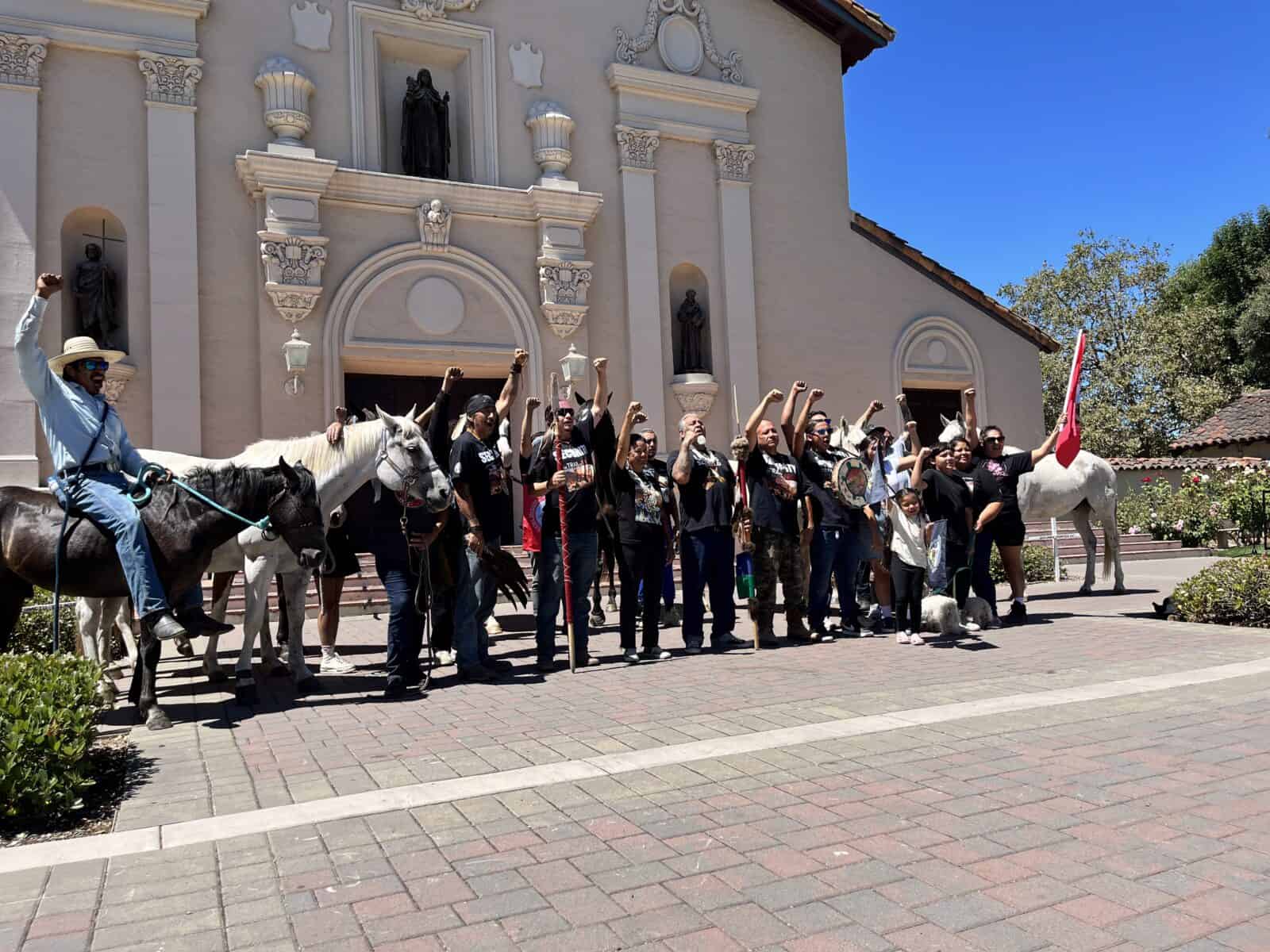
The Muwēkma’s nearly half-century campaign to reinstate their federal recognition is now known as the Trail of Truth, serving as a symbol of perseverance following years of expensive legal suits against the BIA and opposition from special interest parties.
This campaign culminated in a 3,000-mile horseback journey that concluded in Washington, D.C. in 2024.
Another Trail of Truth journey is in the planning stages for 2026 with the “Oglala Lakota Tribe’s sacred line of 17 horses, “gifts to the Muwēkma people in support of our campaign,” Chairwoman Nijmeh said. “Right now, they are stabled outside of the city. I hope to move them closer to the Tribe —there is a lot of healing with equine therapy.”
Chairwoman Nijmeh said they had contacted all tribes across the country to help them on the journey, but initially only the Lakota responded.
However, more joined along the way.
In Washington, D.C., where the Trail of Truth concluded in October 2024, tribal members from federally recognized tribes, such as the Lakota, Menominee, Miwok, Rumsen, Akwesasne Mohawk, Seneca, Oneida of Wisconsin, Lenape, Shinnecock, Piscataway, and dozens of others, were present.
They stood in support when the National Park Service rangers attacked the Muwēkma Ohlone and threatened to confiscate their horses and euthanize them.
“The Capitol Hill police offered to help with traffic control to the BIA, which was our final destination,” Chairwoman Nijmeh said. “But not the NPS, they were aggressive.”
What started as a peaceful rally led to a three-and-a-half-hour stand-off when tribal members sat on their horse trailers to prevent seizure of their horses.
Notably, the National Mall is a National Park, which is public land.
It therefore falls under the jurisdiction of the Department of the Interior, when the former Secretary Deb Haaland (Laguna Pueblo) was at the helm.
In response to the question regarding the chain of command, “That was very disappointing,” Chairwoman Nijmeh said. “Especially from an Indigenous woman.”
At press time, the office of former Secretary Deb Haaland had not responded to an inquiry for comment.
Indigenous Justice Coalition
A youth-led non-profit group called the Indigenous Justice Coalition (IJC) has picked up the Muwēkma’s banner for justice.
Aaron He, founder, president, and lead intern of IJC, is currently enrolled at Bellarmine College Preparatory in San José, a private, all-boys Jesuit school since 1851, and the oldest Jesuit secondary school in California.
Mr. He, who embodies his school motto, “Men for and With Others,” shared why he chose the Trail of Truth campaign as his mission.
I became inspired to create the IJC after canvassing in the Chairwoman’s congressional campaign. Before the Trail of Truth, Chairwoman Charlene Nijmeh was running for Congress. Having learned about the social issues and inequalities facing the Muwēkma Ohlone Tribe in school and other activities such as policy debate. Although she eventually lost in the preliminary race, we pivoted our strategy, reaching out to currently elected officials, and eventually, many students got involved. Going into August for the Trail of Truth, we already had a big base of students helping out the Muwēkma Ohlone Tribe in many initiatives like finance, legislative affairs, and marketing. Helping them on the Trail of Truth was just a natural extension of our work. I think it’s important that we, the youth, use our voices because we need to learn how to be the leaders of tomorrow.
This past June, the IJC took the Trail of Truth campaign to Washington, D.C., as a student delegation, engaging with policymakers on behalf of the Tribe.
IJC has demonstrated its tenacious commitment (including an official endorsement by the Muwēkma Ohlone) by raising $500,000 in grants, connecting with 100 local, state, and federal political leaders, teaching and mentoring 2,200 students as social justice advocates, and having an impressive roster of approximately 85 volunteer members.
The most significant omission on the list of political connections, however, is the current governor of California.
In response to the question of why the office for Governor Newsom was not listed, Chairwoman Nijmeh said, “When Governor Newsom was the mayor of San Francisco, he willingly took meetings with us all the time and was very supportive. Now, all of our requests for meetings are met with silence.”
“I think protecting relationships and sponsors has become more important, not just for him but for many of those in office,” Chairwoman Nijmeh added.
By seeking justice for the Muwēkma Ohlone, the IJC is undoubtedly driven by the highest altruistic objective, and through their actions, they are healing past traumas inflicted by the Spanish Crown and the Catholic Church, primarily the Franciscan Order.
And surely, it honors the Ohlone ancestors waiting for their forever resting place.
Chairwoman Nijmeh shared, “One of our elders, Hank Alvarez, recently passed at 100 years old. He spent his whole life advocating to restore our Tribe’s status with honor and dignity. Sadly, he never saw our status restored.”
Despite their struggles to reinstate their federal status (the required government applications for reinstatement have checkboxes completed literally), the Muwēkma Ohlone Tribe has not only survived but actively contributed to the revitalization of their cultural and language heritage.
Their engagement in community events keeps their presence relevant and meaningful, connecting them to their ongoing heritage.
Makkin Mak Nommo
Having witnessed 236 years of U.S. democracy and knowing the power lies on Capitol Hill—to quote Alexander Pope, “hope springs eternal in the human breast.”
For the Muwēkma Ohlone, the hope is to find a benevolent public servant with a moral compass and a connection to their humanity, who will sign their petition for reinstatement, thereby correcting more than several bureaucratic mistakes with one signature.
That hope lies in meeting with the newly nominated Assistant Secretary for the Department of the Interior, William (Billy) Kirkland III, a citizen of the Navajo Nation who recently served as special assistant to the current President of the United States.
Or perhaps with Bryan Mercier, who is enrolled with the Confederated Tribes of the Grand Ronde Community of Oregon and also became Director of the Bureau of Indian Affairs in October 2024.
Leadership in the BIA has had a higher enrollment of Native members since its inception.
One always hopes that with a collective of voices raised for justice, the decibels become impossible to ignore.
And with the reformation of colonial policies favoring California’s First Peoples, the Muwēkma Ohlone Tribe’s message, Makkin Mak Nommo can truly resonate with peace and experience spiritual nourishment through Earth in their children’s lifetime —and for those after them.
If you are inspired to support the Trail of Truth campaign, whether by donation, signing an open letter to Congress, or as a volunteer with IJC, please visit:
or