

Wileety Native American College offers cultural education at Sac State
By shaylyn martos
This fall, the Wileety Native American College (WNAC) opened for Indigenous students and anyone hoping to learn from tribal leaders and experts. The college is the first of its kind and designed to uphold cultural and community values from tribes across the country.
During the grand opening on September 24, Wileety (pronounced Wuh-lehh-too) welcomed 34 CSU Sacramento undergraduate students, which collectively represented around 25 different tribal nations. The name Wileety is a Plains Miwok term meaning “to bloom, to be bright, to shine.”
The college’s inaugural dean, Annette Reed, Ph.D. (Tolowa Dee-ni’ Nation), inspired many within the Sac State community as an educator and a tribal elder since she joined Sac State in 1998. She cancelled her retirement to lead WNAC in culturally-based education. To her, that means “recognizing different students for their individual culture, also to keep connected to community.”
The college is open, in accordance with state policy, to anyone who is interested in learning about tribal history and governance. Students must first finish the CSU application. Upon acceptance, they can apply to Wileety.
Students who disclose that they are Native American on their application will receive an email shortly after acceptance encouraging them to apply to WNAC online. There will also be access to the application on the Sac State main website for new students. Every student must minor in Native American Studies (NAS), or major in Ethnic Studies with an NAS concentration.
Finding community can be extremely difficult for Indigenous college students. In 2024, American Indian and Alaskan Natives make up only 1% of undergraduate students in the US. Not only can students feel isolated, but Sac State has had controversy in the past. In 2015, Chiitaanibah Johnson (Maidu/Navajo) was disenrolled from her history class after arguing with the professor over the use of the term “genocide” to explain what happened to American Indians.
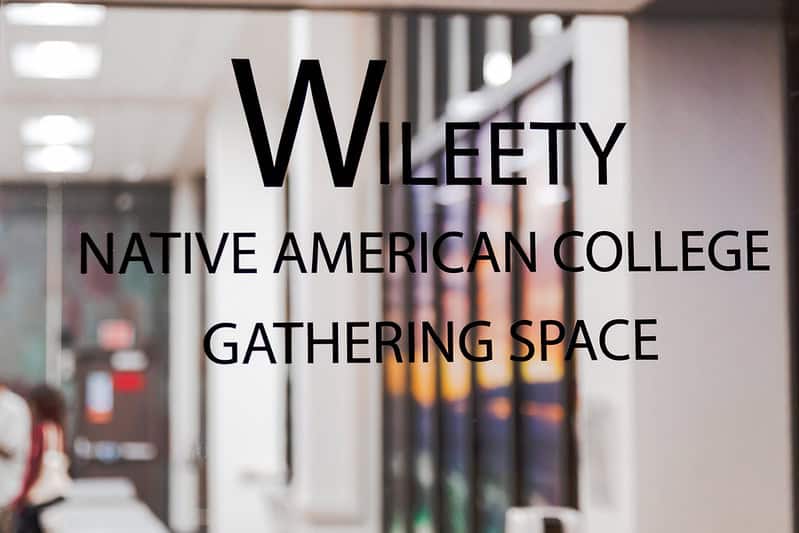
Wileety’s curriculum is designed so students move as a group through general education and NAS courses. For this semester, two courses are taught inside the new Wileety College Gathering Space, and the students receive credit for meeting with mentors, attending talks with tribal leaders, and volunteering as a cohort.
“All of that is in the same class, so that they’re not doing all of these extra activities outside of their classwork,” said Dean Reed.
Every WNAC student and staff member utilizes the new 6,000 square foot WNAC Gathering Space. Inside, there is a huge classroom set up, a conference room that students can sign up to use, a lounge area, docking center, kitchenette and private bathrooms. The Gathering Space also contains the offices for Wileety staff, who each check in with 4-5 students every other week.
“I wanted a space where you walk in from outside. I didn’t want a space where you walk in, go down the hall, up an elevator, down a hall, and there’s your area,” Dean Reed said.
The Gathering Space is centrally located, across a breezeway from the Sac State library. A coffee shop sits between WNAC and the Esak’timá Center, the Native American resource center on campus. When I interviewed Dean Reed, she ended up taking me on her phone through the Gathering Space, showing me each amenity and introducing me to everyone she could find.
Thomas Lozano (Enterprise Rancheria, Estom Yumeka Maidu), is the Outreach and Recruitment Coordinator for WNAC. He’s also a Sac State alum. But during his undergrad, only two Native faculty worked there: Annette Reed and Brian Baker, Ph.D., who now serves as Ethnic Studies Director.
“During that time, there were little resources for Native American students,” Lozano said. “And so for our Native Student Club, we would often have to fight for a table at any restaurant that was at the University Union to have our meetings, or any table that was out in the quad to have our meetings, and so forth.”
Lozano developed lifelong friendships with his fellow club members. Their support, along with Dr.s Reed and Baker, led him to graduate and prioritize a future in Tribal Leadership. Lozano is now in his first semester of a Master’s in Higher Education Leadership and Policy Studies at Sac State, with future goals of an Ed.D. and giving back to the student population.
“They are our future leaders in medicine and in law and environment, and also our cultural stewards,” he said. “So my vision is for one day to have, you know, 50 entering our class, 75 entering our class, 100 entering our class. You know, where we will continue this model of growth, this model of giving back to the community.”
Breanna Lou-Neal Reyes (Eastern Band of Cherokee, Rosebud Sioux), is a junior transfer student majoring in Family and Consumer Sciences. On my tour through the space, Reyes was getting her lunch from the community fridge.
“I do a lot of my work here. I have a three hour break between classes, so I come and get all of the rest of my work done for my online courses. I also am making a lot of pretty great friends too,” Reyes said. “We have that sense of community kind of built in, so all you really have to do is start talking.”
Across from the kitchenette sat Anthony Flores (Kletsel Dehe Wintun Nation), a senior in his final semester studying Ethnic Studies with a Native American Studies Concentration and a Minor in History. Flores also contributed his story “Teecha: Puhtwin Reaffirmation of Puhtwin Identity” to the Summer 2025 issue of News from Native California.
Following his graduation, Flores hopes to study for a Ph.D. in Ethnic Studies. “My nation, Kletsel Dehe Wintun Nation, we’re Puhtwin peoples. UC Davis is on Puhtwin land. So it’s important for me to try to go there, my primary target, take that space.”
For now, Flores utilizes the WNAC Gathering Space for a study spot, as well as connecting with fellow cohort members. “The space really centers Native American experience,” Flores said. He currently takes two classes there; his native biography course is taught by the director of the Native American Studies (NAS) program at Sac State, assistant professor Rose Soza War Soldier, Ph.D. (Mountain Maidu/Cahuilla/Luiseño).
“It isn’t, quote, unquote, a classroom. It’s easier for me to actually navigate and kind of walk between and among the group of students.” said Soza War Soldier. “If people happen to be dropping by the space, they’ll probably hear me. And so whether or not they’re intrigued, and either want to pick up Bad Indians, or take one of my classes just based on what they might hear, I think it’s a good opportunity.”
Soza War Soldier teaches both required NAS courses for WNAC students. She was inspired to enter academia after attending her first California Indian Conference, which was held at Sac State that year. She credits Dean Reed for not only encouraging her education, but also facilitating the hiring of dedicated Native American faculty and staff for WNAC.
“We look forward to having additional hires, whether that’s within the field of NAS or somebody who has a native expertise,” she said. Having more native people working throughout Sac State would introduce students across campus to “the unique positionality of tribal nations and tribal peoples.”
The university’s current presidential administration under Dr. Luke Wood has been integral to the establishment of WNAC. But their collaboration with tribal leaders is complicated by Sac State’s current plans to comply with the Native American Graves Protection and Repatriation Act of 1990.
Soza War Soldier is on the NAGPRA Committee for Sac State. “The Federal NAGPRA law passed when I was in elementary school, and I am an assistant professor now,” she said. “It’s been decades, and [I try] to get people to critically reflect and think about like, how much longer do you want us to wait?”
Both Senior Advisor to the President Mark Wheeler and Vice President of Inclusive Excellence Michael V. Nguyen were thanked for their support at WNAC’s grand opening in September. During my e-tour, they arrived to meet Dean Reed in the Gathering Space.
“We don’t come to the table with a preconceived notion of how this college should function in the ecosystem, but we want to know that we have a college that serves the Native community as well as can be,” Wheeler said. “And Dean Reed and her team know better than we, and so we trust our native leadership to guide us towards this beautiful, bright, shining, blossoming future.”
“In the systems of public higher education in California, so far as we know, there’s no existing model like this,” Nguyen said. “So we’re very excited to see how this grows here and how we can foster an exciting and supportive environment here.”
Wileety provides a safe space for students to work and relax in community, but for Dean Reed, that support doesn’t end at graduation.
“It’s one thing to get students into a college, it’s another to have them be successful and retain them, and get them through to graduation. And then it’s yet another step with what happens after they’re out and doing their jobs.”
Applications for the CSU system opened Oct. 1. This month, WNAC and the Esak’timá Center will hold an information session for NAS scholarships for students.
shaylyn martos is a California Local News Fellow with the UC Berkeley Graduate School of Journalism.