

“Good Fire” exhibition blends art, history and natural science
By shaylyn martos
To Native Californians, fire is a living being – the center of both culture and ecology. Despite centuries of suppression, good fire practitioners continue to resist the effects of settler colonialism and educate new generations in land stewardship.
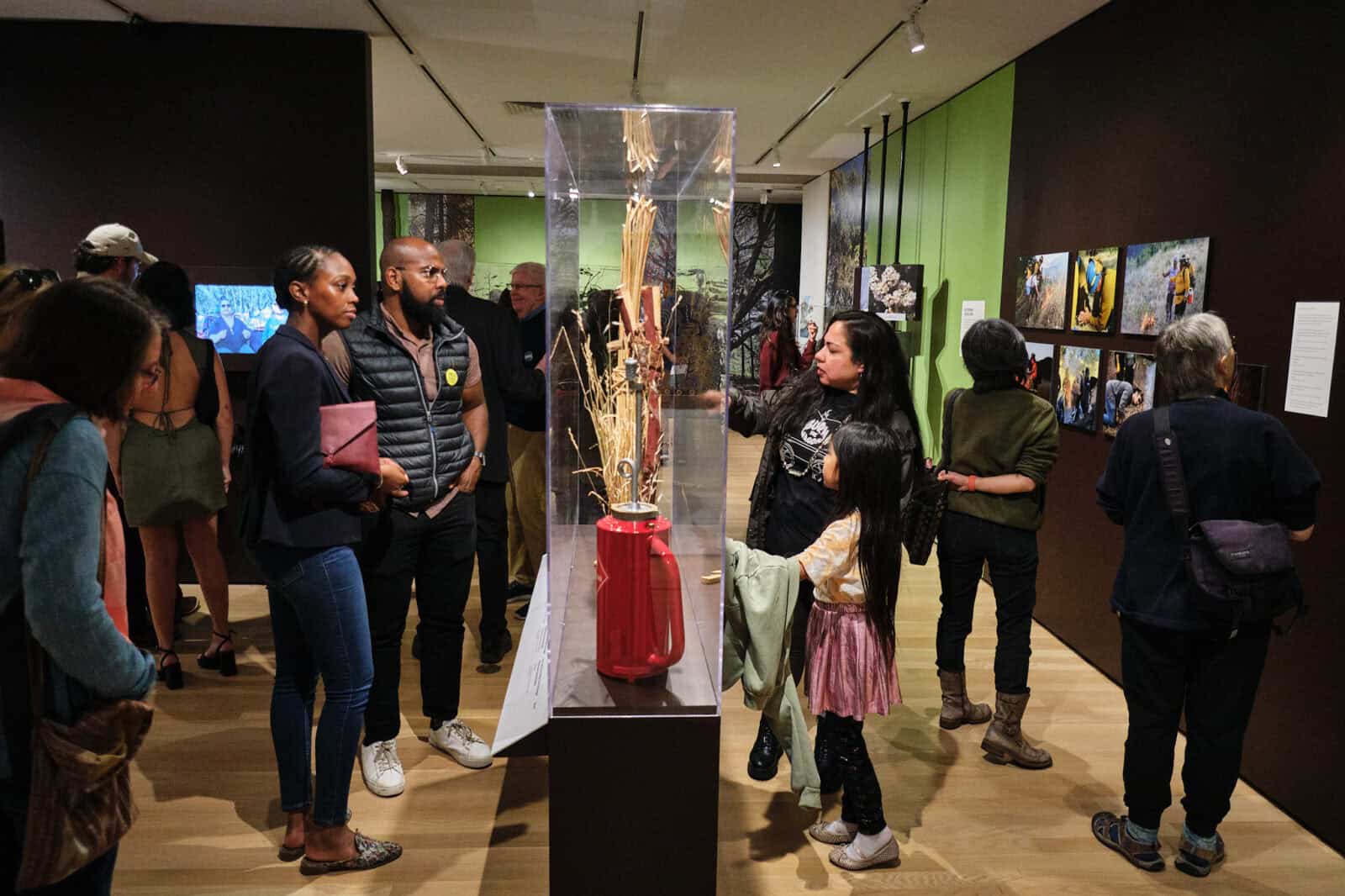
Good Fire: Tending Native Lands, is the latest special exhibition from the Oakland Museum of California (OMCA), showcasing Native perspectives on sustaining healthy ecosystems and ways of life. Many people’s connection to fire is non-existent in 2025, and Good Fire provides an immersive experience that will enlighten any visitor, regardless of prior understanding of cultural burning.
“I hope that the people of Oakland, people from around the world that come to see this, recognize the contributions and the continued presence of California Indian people here today,” said Dr. Brittani R. Orona (Hupa), co-curator of the exhibition and Assistant Professor of Native American Studies at UC Davis.
Good Fire appeals to all five senses, greeting visitors with the gentle crackle-pop sounds of a cultural burn and a map showcasing all the Native Californian tribal territories The exhibition is divided into three parts. The first, “Working with Fire,” features practitioners’ tools and regalia, fire-dependent plants and animals, and multimedia narratives about the beginnings of fire.
Regalia maker Tiśina Parker (Southern Sierra Miwuk/Kutzadika’a Mono Lake Paiute and Kashia Pomo/Coast Miwuk) committed to using authentic materials for her piece Chi/LOW/pa’. Each shell, bead, and feather was collected; the buckskin hides were brain-tanned; and the stitching is sewn with deer sinew. After the four-year process, she also wrote a fire song, or fire prayer.
“It’s an emotional experience to see a life given to you, and to ask for its feathers, ask for pieces of it in order for it to go into your sacred regalia. So that requires an offering,” Parker said. “And I intentionally sought out work with one of our language keepers and other people from my tribe to create that.”
Across from Tiśina Parker’s regalia are interactive displays depicting fire-dependent plants and their relationships native animals. Visitors can sniff the sweet citrus smell of yerba buena while viewing how birds interact with plants after a cultural burn, and how different plants germinate and root in clean soil.
Frank K. Lake (Karuk) is a fire practitioner who spoke to the interconnected lives of flora like the California black oak and hazel, and fauna like the Pacific fisher weasel and acorn woodpecker. He said the wealth of our regalia, like his on display, is featured in our environment.
“Each one of these animals here has its own story of how to live and work with fire that teaches us the way to steward and be good caretakers of the land,” Lake said.
The practical section of working with fire leads to “Good Fire, Interrupted” – which confronts the colonial legacy of fire suppression. Artist Brian D. Tripp’s They think they own the place, mixed media on paper, was published in a 1992 issue of News. The poster on display at OMCA features Tripp’s message “BUT WE KNOW BETTER” penned at the bottom with his initials.
“If we as a culture value ecosystem health, Indigenous sovereignty over extraction and environmental destruction – we’ll be in a very different place,” said Ryder Diaz, OMCA Curator of Natural Sciences and co-curator for Good Fire. “We also are trying to highlight that there are so many women doing fire, there are so many queer people doing fire, there are trans people doing fire.”
The intergenerational aspects of cultural burning are especially apparent in the final section, “The Future of Fire.” Several short films and baskets are on display, as well as a collection of tee shirts from different cultural burning organizations like the Tribal EcoRestoration Alliance (TERA), which donated cultural and modern fire tending tools to the exhibition, and the Cultural Fire Management Council work to bring health and healing back to the lands.
“Something that I really share with people is that it’s not just an element – it has a life. And the first thing it wants to do is eat, so you better have that ready,” said Diana Almendariz (Maidu/Wintun and Hupa/Yurok), a cultural practitioner who worked with UC Davis to teach good fire practices to students in their tending garden.
“Whenever we burn a field and you just have that all the grass is gone, it’s all black, then what’s going to happen next is it’s going to come up green,” Almendariz said. “That’s what the deer want to eat; that’s full of the nutrients and the vitamins. So we’re seeing this carbon sequestration going on as well.”
While not at the forefront of the minds of OMCA officials and exhibition collaborators, the recent theft of museum pieces cast a shadow over the hopeful grand opening. On October 15, burglars broke into the OMCA off-site collection storage facility and took more than 1,000 items, including jewelry, laptops, six Native American baskets, daguerreotypes, and other artifacts, according to OMCA CEO Lori Fogarty.
OMCA officials said there was no indication that the perpetrators identified the facilities as museum storage, rather they gained access and took items that were most easily available. The museum is communicating with the Native American tribe the baskets originated from, and tribal officials have asked for their name and additional details to be withheld.

Renee Leann Castro (Lisjan Ohlone) is an artist who provided the mixed media triptych “Rinihmu Pulte’irekne” – featuring natural materials and showcasing the past, present and future of good fire in the Bay Area. She is working towards a masters degree in art conservation and is passionate about helping Native people in the repatriation of their cultural objects.
“I like to see things like a basket as an ancestor, not just a basket, not just a piece of artwork,” said Leann Castro. “I think it’s important that I’m in there to help everyone else come in and get stuff out. But while that’s happening, it is still there, and that’s the reality of how it is right now.”
For basket weaver and TERA board member Patricia Franklin (Scotts Valley Band of Pomo), the focus is not on the uncertainty surrounding the investigation, but on the possibility of spreading the message and hope of a good fire future. Franklin said that OMCA is a great platform to uplift that message, and that’s why she allowed her basket to be in the show.
“Every time I let them go, I have to say goodbye, because they’re living too,” Franklin said. “You know, I always say my goodbyes in case I don’t see them. But my hope is always that I will see them again.”
Both the FBI and City of Oakland are involved in the burglary investigation, because the city owns the museum’s collection of 2 million pieces. In November, the FBI released photos of two suspects from the storage facility, asking for anyone who has information to contact their tip line or the Oakland Police Burglary Section at (510) 238-3951.
Good Fire: Tending Native Lands at OMCA opened on November 7, 2025 and runs until May 31, 2026. Entrance to the special exhibition is separate from museum admission and also includes access to Black Spaces: Reclaim and Remain.
shaylyn martos is a California Local News Fellow with the UC Berkeley Graduate School of Journalism.