

OP-ED: Did the CA Legislature Pass Chief Stankewitz’s Last Chance at Freedom?
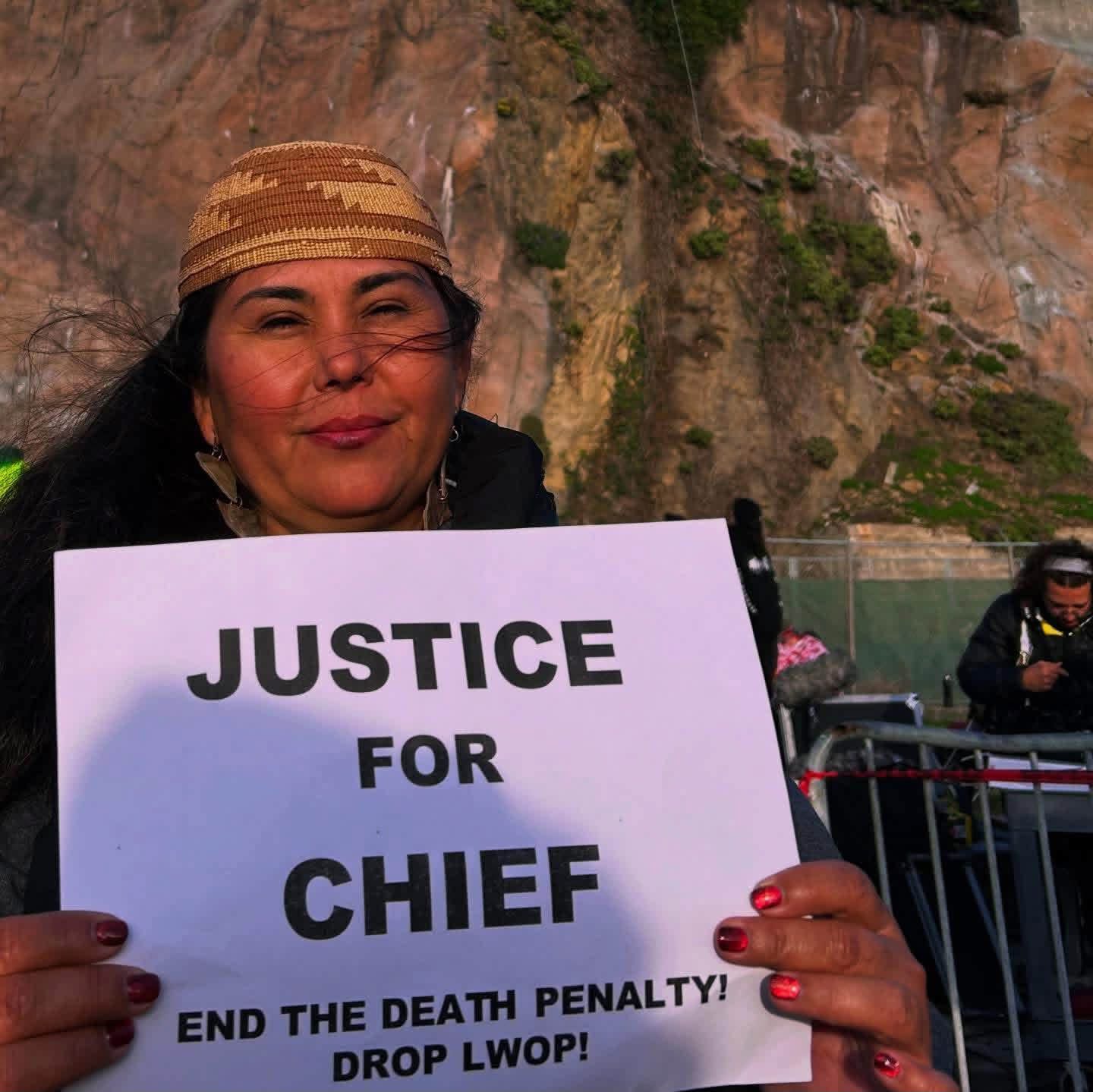
By Morning Star Gali and Filiberto Nolasco Gomez
For the crime of existing Douglas ‘Chief’ Stankewitz, a Monache man from Big Sandy Rancheria, was the first person sentenced to death when California reinstated the death penalty in 1977. Stankewitz was the longest serving inmate on death row until California Governor Newsom issued a 2019 executive order halting executions.
A 2019 revelation that the alleged murder weapon had actually been in the possession of the Fresno Sheriff’s department during the crime should have turned the case on its head. For decades Fresno law enforcement insisted that Chief used the gun to murder 22 year old white woman Theresa Graybeal. Over multiple trials Fresno prosecutors presented false, coerced and misleading testimony to convince jurors to give Stankewitz the death penalty. It turns out Fresno law enforcement knew or should have known that Stankewitz was not the killer the whole time, instead they were blinded by their own bias. In a recent hearing It was also revealed that Detectives inebriated their star witness, 14 year old at the time, Bobby Brown to testify that he saw Chief pull the trigger. Years later he recanted his coerced testimony. While Chief had always known he didn’t kill Graybeal he couldn’t remember what actually happened. In 2019 he finally found some of the clarity he long sought, the evidence proves he was not the killer.
Chief is currently caged at California Men’s Colony outside San Luis Obispo. Through his incarceration authorities never stopped prosecuting and punishing him for being Native. For 20 of the over 40 years he’s been inside, Chief was held in solitary confinement. He was first punished for repeatedly refusing to cut his hair. He is now an elderly man of 68 fighting for one last chance of freedom through California’s innovative and path breaking 2020 Racial Justice Act. The scars of time inside have slowed him down but he remains committed to his innocence. What remains of Chief’s life deserves better than to be a prop in the melodrama of Fresno anti-Indigenous hostility.
Chief’s childhood was primarily shaped by abuse, deprivation and neglect; his adulthood would be shaped by the indifference and corruption of Fresno prosecutors and police past and present along with a turnstile of hopeless and ill-equipped defense attorneys. Another attorney would later admit that he did not offer him an adequate defense
His arrest as a struggling 19 year old fit an easy to digest racist narrative for a jury pool with no Native American jurors. Institutionalized at an early age Chief’s eventual prison sentence was seemingly foretold, a perception that predatory Fresno police and prosecutors took advantage of. The transgressions of Fresno law enforcement towards Chief allowed the actual killer to go free making a mockery of the tragic murder of Theresa Graybeal by fabricating evidence and concocting a narrative riddled with cliches and prejudice.
When Chief was arrested in the 1970s Fresno was laced with heroin enabled by crooked cops and hardened by a long standing rural outlaw identity. Seeded by Leland Stanford in the late 19th century, Fresno was founded to serve the interests of manifest destiny on rails. As the city grew the local white power structure extracted wealth through dominance in real estate and the coercion of Native American, Brown, and Black men into exploitative labor schemes.
The Ku Klux Klan and their surrogates grew in parallel with the city. In May 1924 Klan Karnival descended on the Fresno County Fairgrounds for an entire week. 50,000 members and enthusiasts journeyed from all over the country. As recently as the 1970s and 80s the KKK was still active. Local newspapers reported on cross burnings, rallies and recruiting drives. Various police officers were tied to Klan activity including Fresno County Sheriffs.
Chief’s current efforts at freedom are supported by the devotion of his team of attorneys, the conviction of his own innocence, and the support of his community. However, Stankewitz and his advocates remain incapable of overcoming the inertia of long standing hostility to Native people in a dubious court system.
Stankewitz resiliency reflects what has kept Indigenous people alive despite the despair of genocide, broken treaties and a seemingly hopeless future. Chief’s resilience may pay off as a last chance has materialized. In 2020, Assemblymember Kalra authored AB 2542, the California Racial Justice Act.
Through AB 2542, a person charged or convicted of a crime could challenge racial bias in their case by demonstrating evidence of the following:

- Racial bias from people involved in the case
- Racially discriminatory language during the trial
- Racial bias in jury selection
- Statistical racial disparities in charging, conviction, and sentencing
In a recent August hearing Judge Alvin M. Harrell III found the defense should be given access to discovery evidence, which may include demographic information on cases in which the Fresno County DA charged defendants with murder. Harrell named Fresno County’s history of racism , ordering the Fresno County District Attorney’s Office to turn over evidence.
Stankewitz’s attorneys believe the data they are seeking, from 1972 to the present, will prove there’s been a disproportionately high murder conviction rate for Indigenous, Black and Latinx people in Fresno County. Chief’s legal hopes to obtain records that explain why the only Native American juror candidate was dismissed..
Stankewitz’s next hearing date in Fresno Superior Court is November 6th.
For updates on the Chief Stankewitz, visit Indigenous Justice on Instagram and Facebook.