
Brush Dance Revitalized at Ah PahVillage:
A first person narrative in honor of 2026 California Indian Day
By Tori McConnell
“When we had a brush dance for my son at Katimiin, I remember seeing Willard sitting under a tree afterwards … I came up to him and we started talking, and he said that this is what he wants to do at Ah Pah. That was over twenty years ago.” – Chag Lowry at Ah-Pah Brush Dance 2026
June 2021…
I sat in the passenger seat of my friend’s mid-size SUV as we rolled out of the Costco parking lot. My friend was five months pregnant with her first child, the future was pregnant with hope, and the car was pregnant with food and supplies. There was not even room for even the last item, a watermelon, so I held it in my lap. The car was the definition of “packed to the gills”; my feet were surrounded by boxes and bags and I couldn’t help but imagine how terrible the gas mileage was going to be. But the price of gas seems to deliver less of a sting when you know that your cargo is going to be used for ceremony.
My friend who I was driving with had invited me to help in supporting her extended family’s Brush Dance revitalization efforts at their home village of Ah Pah. Ah Pah is a Yurok village that hadn’t hosted a ceremony in over 100 years due to the damage suffered by Yurok people and land through the Gold Rush and colonization. The family was holding a practice dance to help prepare for the real thing, which would be planned in the years to come. It was 2021 and I had just finished college and I had a few extra weeks of free time prior to employment. I was overjoyed to use my newfound open schedule to help run the kitchen camp.
Ah Pah became a special place to me through that experience. One of the closest neighboring villages to Ah Pah is Surpur, the village my grandma Pat was born and raised at. With Surpur so close by, coming to Ah Pah felt a little extra special.
On the Lower Klamath
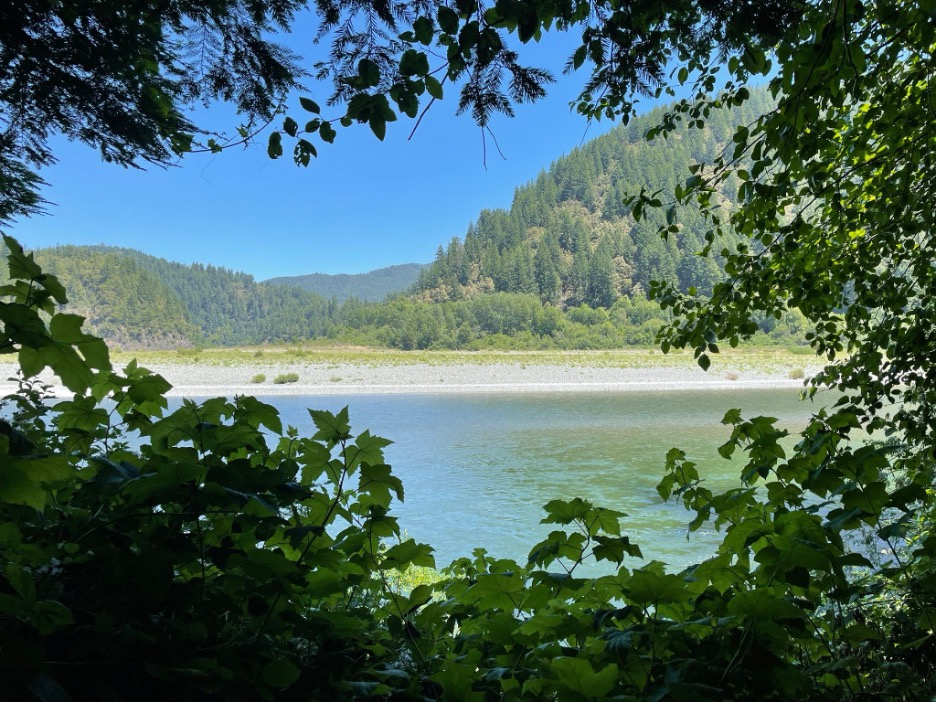
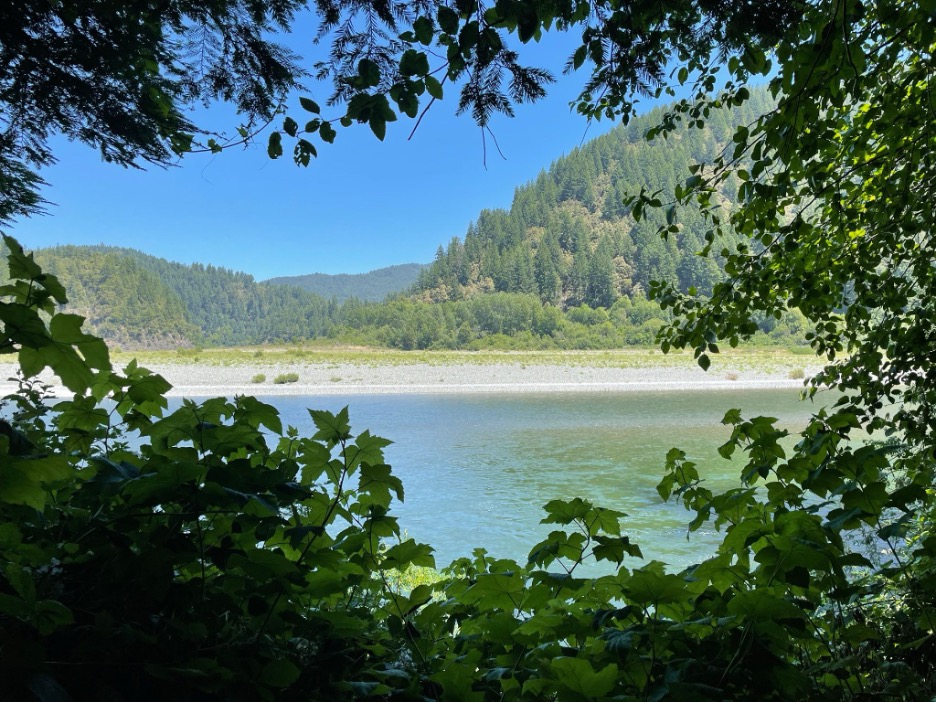
The village of Ah Pah sits just downriver across from the mouth of Blue Creek. The two have become somewhat synonymous, with the village site often being referred to as “Blue Creek Ah Pah Village.” The area of Blue Creek/Ah Pah is located in the heart of Yurok Country about 16 miles up from the mouth of the river. From some of my friend’s teachings, Blue Creek is the center of the world for our people. It’s one of the few places on the small Yurok Indian Reservation where old growth redwood still remains, making Ah Pah a remarkably beautiful place to revitalize old traditions.
This New York Times article from 2012 introduces readers to Willard Carlson Jr. (Yurok), the now-elder who resides at Ah Pah village and began leading the effort to revitalize this site decades ago. One of the family’s main goals has been to bring back the Brush Dance, a traditional healing ceremony for a baby or young child that not only serves as a medicine for the child but also serves as a social event for the community. It is part of our traditional Yurok culture to hold brush dances in our home villages up and down the river. This year Ah Pah joined the list of Yurok summer brush dances.
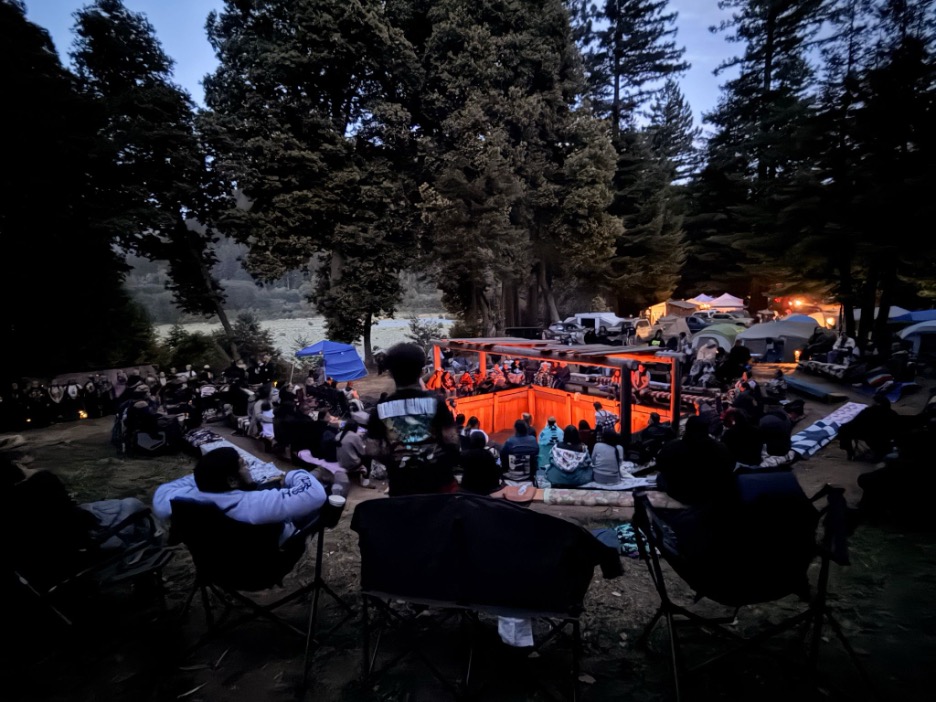
Saturday Night
Rumbling through the dark Klamath mountains, my little ‘06 Subaru Forester carries me and my friends along an unpaved road used primarily by logging trucks and Willard Carlson. I imagine during peak Brush Dance traffic, the road is clouded with dust kicked up by NDN cars making the one-hour descent from Highway 101 to the riverside.
“You really can feel everything in this car,” my friend, former Graton Hey Day Berkeley Roundhouse Writing Intern Muriel Ammon (Tsunungwe/Hopi) says. I chuckle.
“Yep.”
I see shadows of small rocks and fluttering white moths illuminated by my car’s high beams. It’s around 10:30pm and with the sun long gone I feel impatient so I’m hurrying as quickly as I can. With precious cargo I’m making sure to drive safely, but on a dirt road like this one, driving “safe” does not necessarily mean that it’s “comfortable”.
“Woooo…. Feels like Indiana Jones!” Cecilia, Muriel’s sister, giggles as we roll over a dip that almost makes our stomachs turn. I laugh out loud.
“Welcome to my reservation,” I joke. I didn’t grow up on the Yurok Indian Reservation. Having made early core memories on the reservation growing up, though, it still feels like home. It’s fun bringing my Tsunungwe sisters on a journey to the heart of my homelands. Even though we giggle about my driving and how my car’s suspension sucks, I think they are enjoying it too.
As we near the village site we see cars parked tightly along the edges of this treacherous dirt road. I turn right into the “parking lot” area. It’s just a flat surrounded by trees that leads to another narrower dirt road. Cars are parked anywhere they can fit, making the drivable space too narrow for even my small Subie. I start backing up, but it’s real tight. A helpful guy with a big beard appears out of the darkness and without having to be asked, starts giving directions through my rearview mirrors.
“Oh! That’s our cousin,” Muriel says.
“Ha, he’s helping me but little does he know he’s also helping his cousins who are riding in this car!!” I’m pleased, but not surprised, that out of all the people at the dance it’s Muriel and Cecilia’s cousin that happened to appear to help us maneuver out of a tight spot. I’m not surprised because that’s often how things work out at ceremonies and in life. Coincidences, the kind that remind us that we stay connected. I roll down the windows to say hi, we share smiles and laughs as we greet each other and carry on with our respective agendas. With my car reoriented I zero in on a random open spot between two cars on the other side of the flat. It’s in front of my close friend’s car. Another coincidence. I parallel park on the gentle incline of the dirt road and we unload ourselves from my car.
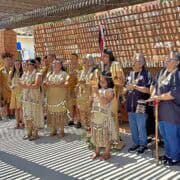
As we meander down the gravel road towards the village I hear the familiar, sharp hollers of men jumping center in rhythm with the song and backup singers. The music of the dance and its surrounding quietness greets us as we emerge into the village site. Quickly adjusting to the ambience of ceremony, Muriel, Cecilia, and I find a place to stand and observe the rest of the dance. It’s the Yurok round, the first round of the long night ahead. Since we were late to arrive, this round finishes after a few more minutes and the dancers file out of the dance house.
The village site is teeming with people. It’s staggering. I didn’t even know this many vehicles, people, and tents could fit down here. During the small amount of time I spent at Ah Pah when I helped here years ago, it was quiet and there were maybe forty people at the most. I was here on Thursday night for the first dances, and there were a lot of people but still not this many people. It seems like there are at least two hundred. Families have gathered from all over to support and watch the dance. Camp lanterns illuminate familiar faces working in the kitchen area, including some of my cousins and friends. Women are working hard brewing tea and coffee for constant refills to service scores of guests and dancers who will be staying up all night. Not me, I have to take a short nap around midnight to make it through. Can’t pull all-nighters like I used to. In the middle of the night, I’m awoken by one of my favorite songs echoing through the river gorge. I get up and rejoin the onlookers who’ve made it to the darkest hours of the night. The air feels delicate and cold.
Morning Rounds
My cousin Marisa once created a small coffee business called “Morning Ground”. It was a reference to the morning rounds of brush dances. It’s clever because no one can stay up all night and make it to the morning rounds without – you guessed it – coffee. Some of the strongest, most powerful, feel-good coffee I’ve ever had in my life came from a brush dance. And this morning, you can bet that I’m gonna be treating the coffee station like it’s a water fountain.
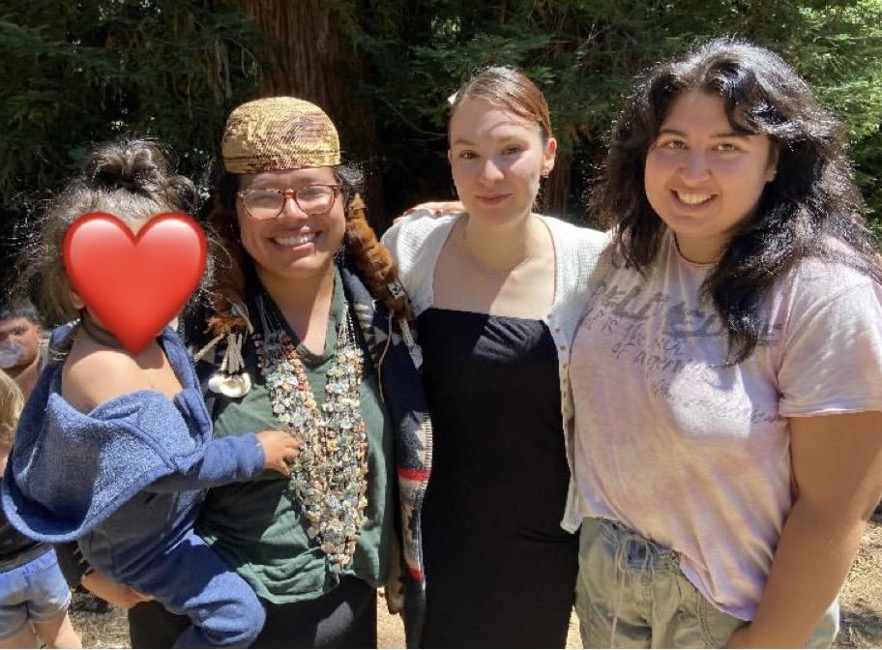
Some people at this dance have it a lot harder, though. Sure, there’s supporters and observers who have resisted the temptation to nap during the night. But there’s also people who have been doing hard labor in the kitchen through the wee hours of the morning. And there’s the dancers, especially the ones who are packing medicine. At every brush dance, there’s a medicine girl and a medicine boy who carry medicine to help the medicine woman. The medicine people all have to fast, usually for ten days and then on the final night of the ceremony they have to stay up all night after their body has already been purified and weakened by fasting. This year, the first medicine packers for Ah Pah are Carmen Pratt and Vaskak Montgomery, two teenagers with connection to the host family. Each medicine packer is chosen for their exceptional strength, dedication, and purity of heart and mind that qualifies them to carry medicine for ceremony. The medicine woman, Victoria Carlson, known among the community as a dedicated advocate and teacher of Yurok Language, is making brush dance medicine at Ah Pah for the first time and it’s amazing to me. She dressed me here at Ah Pah all those years ago for the practice dance, and she successfully encouraged me to sing and dance in a few ceremonies thereafter even though I had always been too shy to do so as a teen.
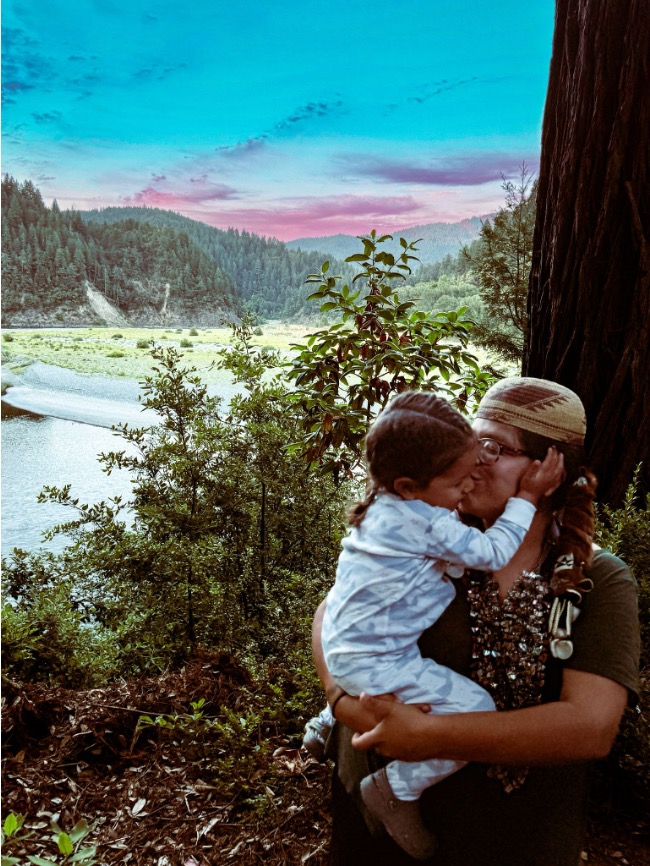
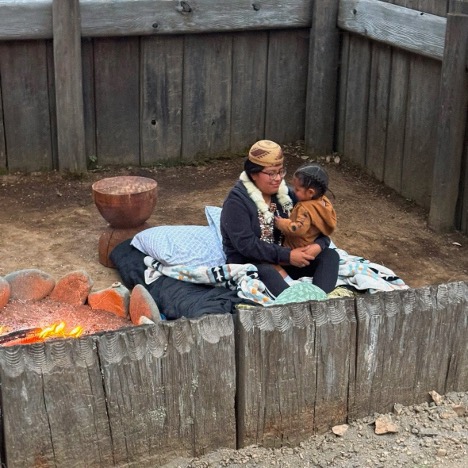
Wakara Scott, my friend and relative, is the one who specifically invited me to the dance. It’s Wakara who’s sitting all night in the dance house with her baby son Tey-wo-lew, the little man who’s the reason why we have all gathered here. He’s been sleeping on and off all night, but when he’s awake he’s the happiest, most brush danc-y baby you’ve ever met. On a normal day he likes wearing traditional necklaces, he dances and claps to the beat, he speaks baby language to show his approval and he even sings sometimes. So although his momma is totally wiped out from the night, he’s having a great time while the sun rises to welcome another day and another set of morning rounds, including the final dance: the Medicine Round.
It’s getting later into the morning, that time when the heat of the sun makes itself known. All the fanciest, most beautiful regalia is coming out for the last round. Men with deer belly head rolls decorated with red and green bird scalps carry bunches of arrows in fancy quivers made from otter hides. Big dentalium and abalone necklaces sway back and forth when men and boys take turns stepping out to jump center. They’re scaring away the last of the sickness. Some of their morning feathers bob up and down like antennae as they keep the circle moving, arms interlocked with the young ladies between them. Girls’ basket caps peek up above the in-ground redwood walls of the dance house. I can see the girls’ pretty dresses as they cycle through the house. One of my favorite parts is seeing what designs are made with beads, shells, beargrass, and fringe that heavily adorn every buckskin dress. Their tops are covered with beaded and dentalium shawls, yards and yards of shell necklaces that took years to make and collect. The medicine girl and boy wear matching buckskin sashes decorated abundantly with red pileated woodpecker scalps. Each one cradles a small basket with both hands and together they step out to do the medicine dance, and when they finish their part the rest of the round ensues to gently close the final piece of this all-night ceremony.
Some people go home right away, but most stay for food. Brush dance food is, once again, some of the best food made by some of the best cooks – Indigenous women make the bulk of the food, while it’s usually men who cook the salmon. The food served at Ah Pah fills my plate with tastes of my home and my childhood. As I go down the line of smiling servers, ttender Klamath salmon cooked traditionally on redwood sticks, breaded fried sturgeon, water fried potatoes with deer meat gravy, potato salad, colorful vegetable and deer meat stir fry, acorn soup, and more modern traditional family foods are piled onto my thick Chinet paper plate. I sit down and already feel the regret of not taking a picture. You just can’t get food like this anywhere else. Home and ceremonies are the only places where a girl’s Indigenously primed taste buds can be satisfied. As more people finish their food, they trickle out of the dance grounds. Everyone needs to go home and rest, including me, but the sadness of leaving ceremony becomes palpable. I don’t want to leave this place, and most of all, I don’t want to leave these people.
But Ah Pah is now in 2026, after generations, a place that shows our community and all California Indians that healing is still happening. Old ceremonies live on for new babies; old villages are preserved and protected for new houses and new camps. When the gold miners and settlers came, the Klamath River ran with the blood of our Indian people. But before that, the River first ran in our blood, in our veins. Today we are here to enjoy our ceremonies, the free running salmon, some of the last old growth redwood that remains along its banks, and each other. This ceremony that brought together an entire community to pray for Tey-wo-lew also brought songs, dance, and medicine back to a remote part of the Yurok reservation for the first time in many decades. And even though I’m sad to leave for now, I know we’ll all be back. Because this was the perfect weekend making medicine and prayers for baby Tey-wo-low, and I am sure those prayers were all made with the intent not just for the brush dance weekend, but for the growth and wellbeing of this ceremony for the next years to come.