

Entering a new calendar year is a time for reflection. Winter is a time for rest, hibernation, and storytelling.
By Tori McConnell
Moving into winter I wanted to reflect on one inspirational piece of popular media that took the world by storm – a golden, technicolor, musical storm. Anyone that has children in their life has probably heard of or seen this movie at least once, if not dozens of times. Both fun and serious, this movie was meant for children but it featured a storyline with meaning that seemed a little deeper than the flashy costumes and catchy soundtrack might suggest.
I was first introduced to the film by my five-year-old niece in New Mexico who was watching the movie in increments like a TV show, turning the movie on and off throughout the week. I love when kids aren’t yet bound by convention, navigating things in their own way. I reclined with her in our pajamas on her parents’ bed one lazy morning.
“They can fly,” she explained to me before popping a big juicy blackberry into her mouth. She was narrating the scene in which main character Rumi and antagonist Jinu joined hands, together singing the song “Free” while imagining a future in which they could both be free from the soul-hungry demon king Gwi-ma. That’s right, if you haven’t figured it out yet, I’m talking about the sensational Netflix film slash musical, Kpop Demon Hunters.
“What does this have to do with Native News?” You might ask. Yes, I see you shaking your head, chuckling. I shall give you the most obvious answer first: as modern Natives, we are impacted by popular culture. Hordes of children chose to dress up as characters from Kpop Demon Hunters for Halloween this year; I was a huge fan of one of the Jinu costumes I saw from a kid at Yurok Tribe Headstart in Eureka. I mean, even during an AICLS conference (Advocates for Indigenous Language Survival) one of our Tolowa language kids was watching Kpop Demon Hunters on her iPad to keep herself occupied throughout the day. That’s when I truly noted, this is not just a pop culture moment. Even the most culturally-centered families today are still impacted by modern media. This has been a point of worry for the state of California Indigenous languages. Language leaders of both the present and times past have prudently posited that domination of English exacerbates the endangerment of Indigenous languages. If this is true, how do we overcome it?
The movie Kpop Demon Hunters is originally in English with a sprinkling of Korean language in some of the songs. But stay with me here as I rewind to my first exposure to non-Western media. You see, I started watching Korean dramas during the start of the pandemic. The more I watched, guided by English subtitles, the more I thought: The Koreans are so blessed. They have so much amazing media content and stories in their own language, in their own culture. Traditional themes and frameworks remained present throughout many of the shows. Some of my favorite shows overall were period dramas set in the Joseon era. It made me wonder what it would be like if California Indians had TV shows and media set in our pre-modern times. Of course, the people of Korea have had struggles to preserve their people and culture. But they have a thriving popular culture that’s gained global recognition thanks to being an independent nation supported by a rich and beautiful heritage. I don’t want to idealize Korean culture or minimize their historical struggles, but I hope you see what I’m saying here. For the first time in my little life, seeing a non-Western culture and language thrive in popular media was truly inspirational. It germinated in me a conception of some parallel universe in which California Indians would have existed, or could someday exist, with a media presence of our own. Because we, too, have beautiful, mystical, vibrant cultures that thrived as the primary cultures of these lands. Now that we are bringing these cultures back into the limelight after surviving the unthinkable, I can’t help but imagine someday when we have films and TV shows and songs and media that will be able to inspire and uplift the rest of the world with our own modern iterations of California Nativeness.
Circling back to the issue of California Natives trying to preserve our cultures and languages while living within a larger non-Indigenous society, I urge my California Indian cultural community to selectively look for inspiration rather than obstacles among the offerings of popular media. What I mean to say is, it is true that the pervasiveness of the English language can make it difficult for us to preserve our own Indigenous languages and culture here in the United States. But it is also true that we can turn around and use these massive productions and far-reaching media campaigns of Western society as inspiration to deepen our own cultural work, whether it be creating modern music and art or translating movies into our own languages.
But beyond being a pop culture sensation, Kpop Demon Hunters stood out to me as a Native viewer because it still centered some core values that are actually quite Indigenous in nature. While following the plot, a Native person can draw parallels to our own Indigenous beliefs and cultures. We see tradition and culture front and center through the Saja Boys. We’re reminded of the profound power of singing and music alongside intergenerational struggles and trauma and the fight to overcome hate, guilt, fear, and shame. These themes remind us of our own cultural teachings, ones that hold true across every Indigenous family and tribe. Those who pay close attention to the movie will see that this is more than a colorful kid’s show with catchy music – any true endeavor to connect with the plot and characters can elicit some heavy-hitting emotions. Bright colors and upbeat songs didn’t keep my eyes from filling with tears at several points throughout the film. If I could relate to the themes, I could only imagine what countless other viewers must be feeling.
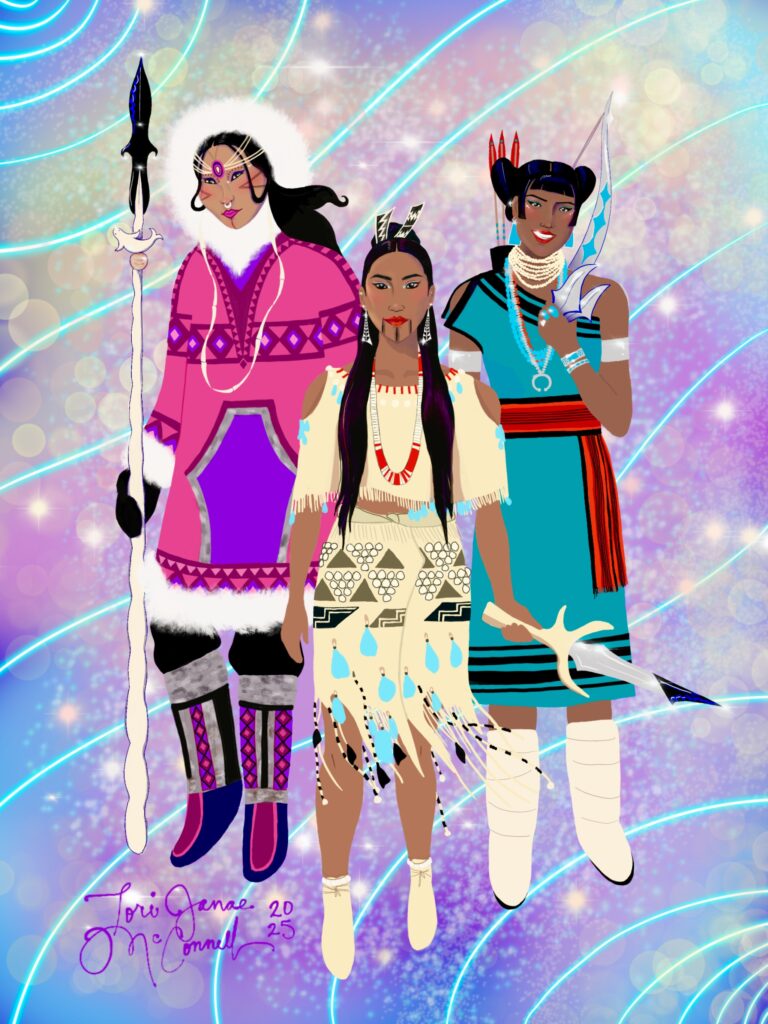
After a healthy emotional release came time to revel in the fandom. I started seeing videos and edits of Kpop Demon Hunters characters on social media – dozens, if not hundreds of them. Images and video compilations of the characters singing and dancing filled my explore page. One particular type of post caught my eye. Some of these videos and images of the first generation of Demon Hunters as depicted in the film. These three original Hunters were dressed in beautiful traditional Korean garb, which inspired digital artists across the internet to create illustrations of Demon Hunters as if they were from their own countries. I’ve seen artists creating Mexican demon hunters, Northern European hunters, African hunters, and more. But one in particular struck me, and I couldn’t get out of my head: Demon hunters from America. I was pleased to see that the artist drew them as Indigenous Americans, but they lost some points with me when it became clear that the artist did not do their research on the diversity of Native American cultures. The characters in the drawing were all wearing plain brown leather dresses with plain brown moccasins. No color, no special hairstyles, no beads or shells. As a former Miss Indian World representing California in the cultural diversity and beauty of Indigenous women everywhere, I could not let that slide.
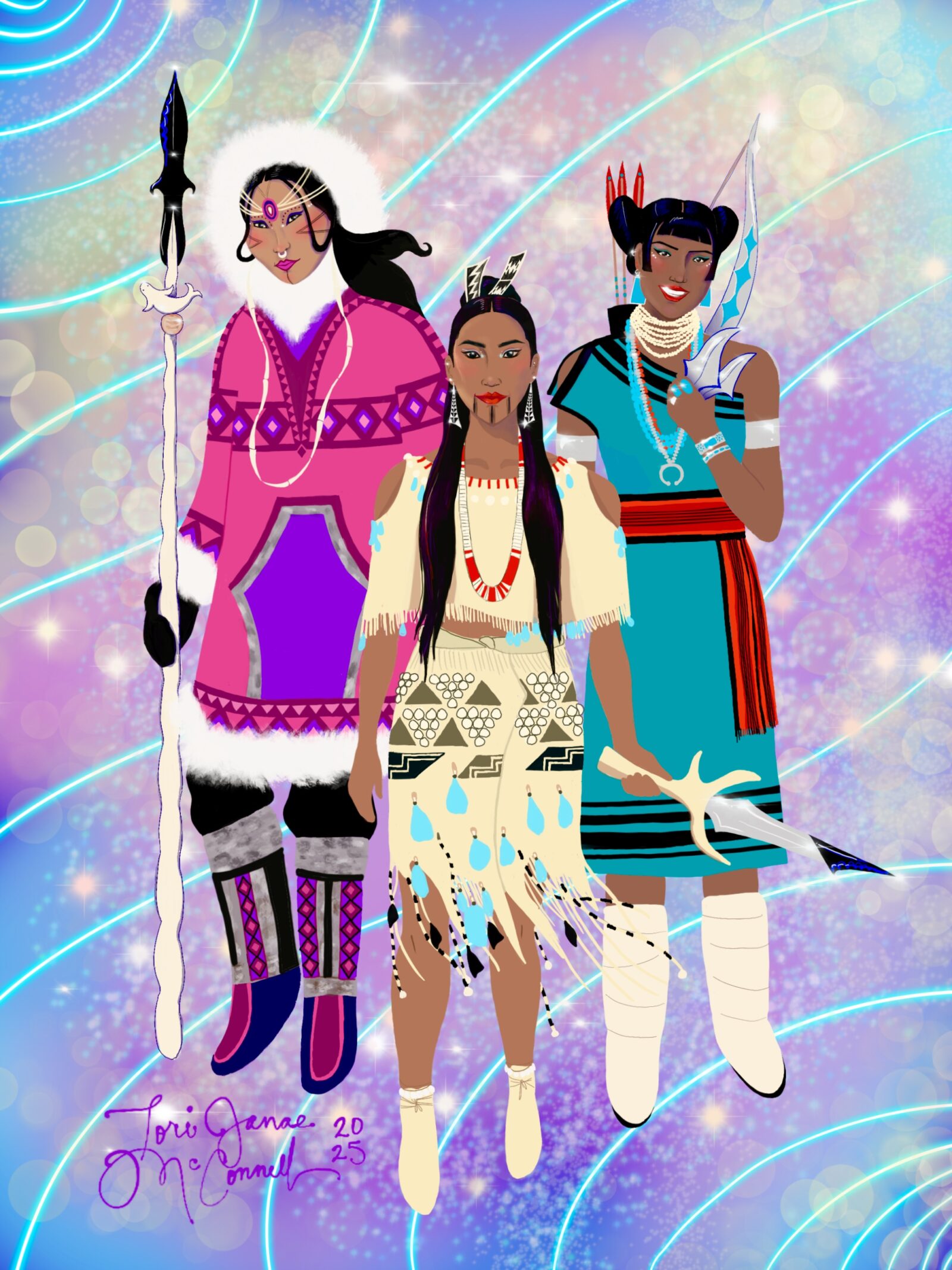
So, I did exactly what you’d think I would do. Yep, I drew my own version of the original Kpop Demon Hunters as if they were from America. On the left, an Inuk woman. On the right, a Hopi woman. And in the middle I put a California Native – that’s right, just for you, my lovely Native News from California Readers.
What inspiration have you taken from Kpop Demon Hunters or any other current popular medi? Has it prompted you to create any visual or musical arts using your own cultural experiences? If you’d like to see your artistic creations featured on the blog whether it be drawings, music, costumes, or language work, feel free to share them with me at tori@heydaybooks.com! I’d love to share what you have created.