First full-time News reporter returns to her roots
By shaylyn martos
Håfa adai!
It is my honor to introduce myself to the News from Native California audience as Heyday’s first UC Berkeley California Local News Fellow. I will serve as a reporter for the quarterly magazine and weekly blog for the next two years – a dream for an early-ish-career journalist like me. My work always centers solutions-based reporting and storytelling with integrity, and I am inspired by those incorporating Indigenous knowledge and counter-culture practices to provide for our collective future. To my delight, I learned that News supports my goals of exploring how gender and sexuality helps guide Indigenous folks today. This opportunity feels like the culmination of my efforts to sow seeds in my writing career; now my job is to learn from experts in Native California’s history and ecology.
When asked to write this introductory essay for our blog, I felt compelled to acknowledge my feelings of unease about my position. During our week-long orientation at UC Berkeley, the team of women who lead the Local News Fellowship took great measures to make us newbies feel welcome and informed. Since fellows are stationed across the state, our experiences over the next two years will differ greatly. We learned about our benefits, our union, and covering identity and immigration; we were also encouraged to explore the campus and spend quality time with our cohort. But while I coo-ed at the triceratops skulls in the Life Science building with my new friends, my employer released the names of around 160 people to the federal government for expressing their free speech rights.
Those affiliated with Berkeley and open about their support for the Palestinian people were endangered by the institution, despite the administration’s long-time claim to protect students and staff’s rights to free speech and public safety. Peyrin Kao, lecturer for the UC Berkeley department of Electrical Engineering and Computer Sciences, recently suspended a hunger strike that was taken in renunciation of the institution’s compliance to genocide. His name was one of those released to comply with an investigation into alleged antisemitism by the US Department of Education’s Office of Civil Rights.
All land struggles are Indigenous struggles. UC Berkeley still holds thousands of native California people’s remains. The university is required by the Native American Graves Protection and Repatriation Act (NAGPRA) to conduct inventories of native remains and associated funerary objects and make them available for affiliated Indian Tribes to claim. NAGPRA passed in 1990, and over 30 years later, Berkeley lags behind others in the UC system in returning the Indigenous people they seized for their museum of anthropology.
I asked my new editor, the fantastic Terria Smith, for her permission to address the discomfort I felt as an Indigenous Berkeley employee. She said Heyday and News from Native California consistently hold the institution accountable: “This is part of what we do.” Terria referred to the 2023 Heyday title The Scandal of Cal: Land Grabs, White Supremacy, and Miseducation at UC Berkeley by Tony Platt. This discerning look into Cal’s founding principles gives context for the situation of tens of thousands of students and staff, including academic researchers like myself.
That’s when I realized that I am in a privileged position amongst my cohort to acknowledge Cal’s misdoings while protected by my outlet and my union UAW 4811. Since Heyday’s first title The East Bay Out in 1974, and when News from Native California began printing in 1987, this team has worked to uplift Native perspectives in a tangible way. The fact that not only will I be able to hold my feature stories, but those stories will only exist in the physical magazine, that’s truly so appealing to me. It is ironic to be a native person with Ohlone ancestry employed by the very university built upon the Huichin shellmounds of my ancestors. But working for the UC system grants me access to resources, and the Heyday team gives me the support to apply my prior experience to this new community.
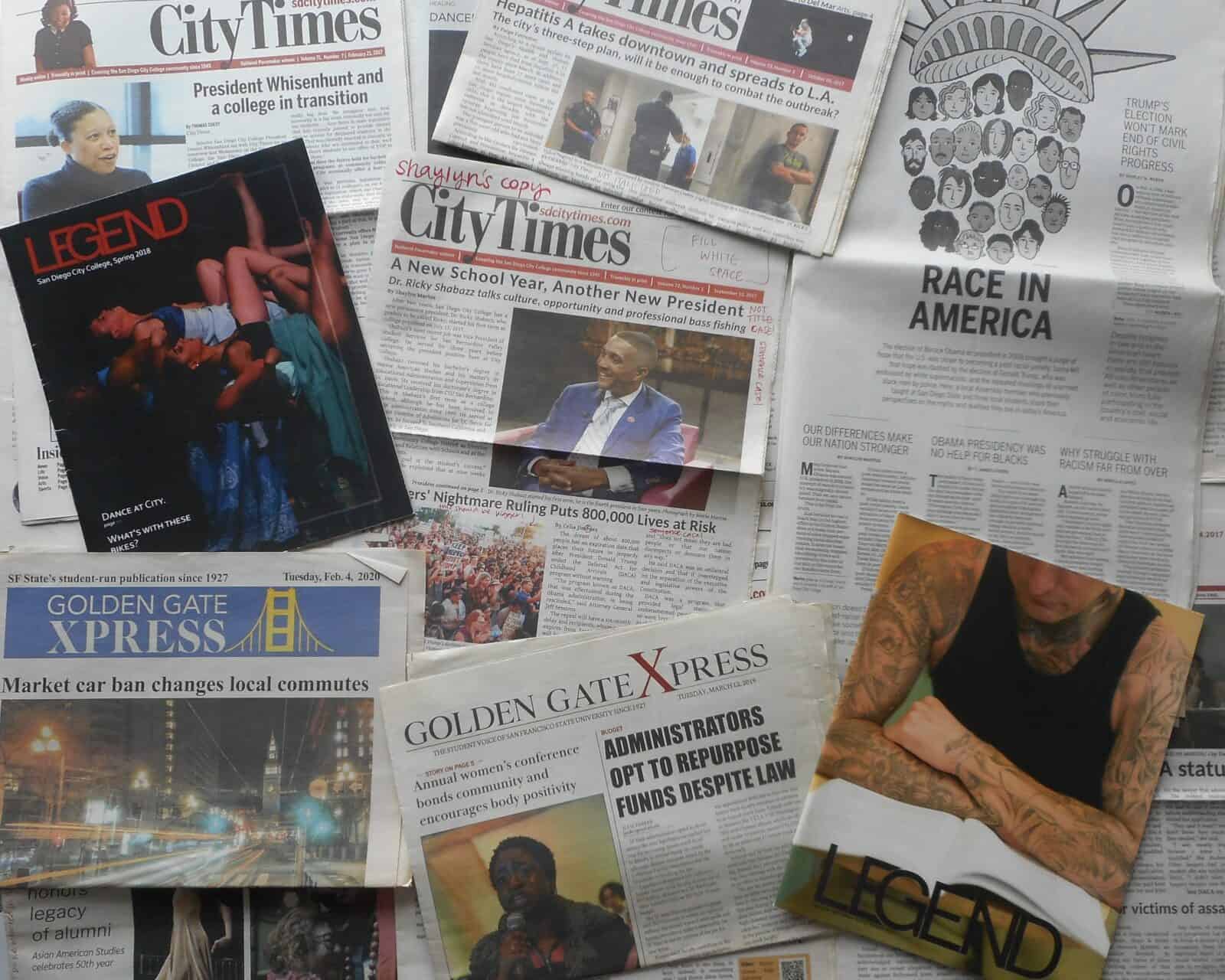
In the basement of the BT building in San Diego City College, I fell in love with print. Working with City Times and Legend magazine fed the parts of me starving for direction and connection. Each issue – the gloss on a page, the smell of fresh ink, the sound of a shutter click and feedback in a microphone – was indelible proof that I was an active member of my community. Feature writing for News feels like I’m returning to my roots but with nearly a decade of lived experience. Over these next two years, I hope to find community and cover their accomplishments and struggles with integrity. I also hope to grow my understanding of my identity as a mixed native person. As I learn about the more than 150 Indigenous tribes in California, I feel the words of my beloved fino’ CHamoru from the Marianas Islands ring true across cultures: Pulan i tano’ ta un pulan i taotao, watch over the land and you watch over the people.
Stepping into the Heyday office, seeing floor to ceiling bookshelves and posters marking literary history, I felt I was gaining access to a wealth of knowledge I previously could only dream of. I left my first day with an armful of borrowed Heyday titles to guide my reporting. I promise to return them in pristine condition for our next readers.
Reach out to shaylyn@heydaybooks.com with any questions, comments, or to share your ideas for features in News from Native California.