The World Premiere event for “People of the West”
By Jeanne Ferris
Growing up in Los Angeles, I saw TCL Chinese Theatre (then Grauman’s) as iconic as the Hollywood Walk of Fame.
At about eight years old, I visited the famous footprints and handprints of celluloid heroes.
I remember bending down and stretching, enjoying the rush of blood to my head as I tried to fit into Sophia Loren’s imprints.
Now, years later, I find myself returning to this legendary theater for a new reason: I am attending the world premiere of People of the West.
As I recline to watch a California Native story, told through Native voices in Theater Six, the giant screen and full theatrical audio echo in my chest like a second heartbeat, recalling memories of childhood visits.
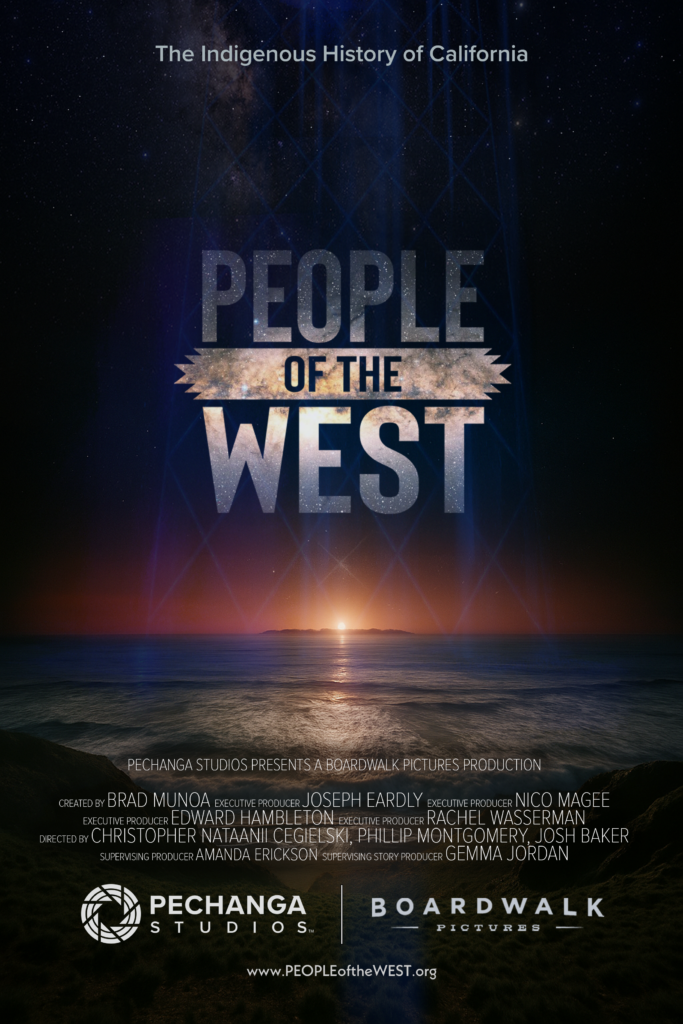
PEOPLE OF THE WEST (POTW), Episode One: First Contact, is a landmark docudrama that debuted at Dances with Films (DWF), a respected bi-coastal independent film festival.
POTW earned a Series Audience Award on closing night, marking its significant historical impact, and likely the first of many this year.
Pechanga Tribal member and Creative Director, Mr. Brad Munoa, shared his reason for choosing this festival.
DWF is a champion of true indie filmmaking, and to quote the actual rule from their website: “No Politics. No Stars. No Sh*t.” We wanted to reach as wide an audience as possible, Native and non-Native. Which made it even more poetic for us, because in the spirit of independence, we made the series on spec, with complete creative control and without studio restrictions or oversight.
It is not a romanticized Wild West story but a truthful, authentic account from an Indigenous perspective.
Film directors Christopher Nataanii Cegielski, Navajo (Sitting Bull), Phillip Montgomery (Sitting Bull), and Josh Baker (Kin) oversaw the recreations in the series.
Joseph Eardly, Showrunner/EP, Mr. Nico Magee (Payómkawichum/Cupeno), and Mr. Munoa oversaw the entire series from preproduction to post-production.
Mr. Magee said, “It’s a Pechanga Studios production with Boardwalk Pictures, and all episodes are completed and ready for distribution.”
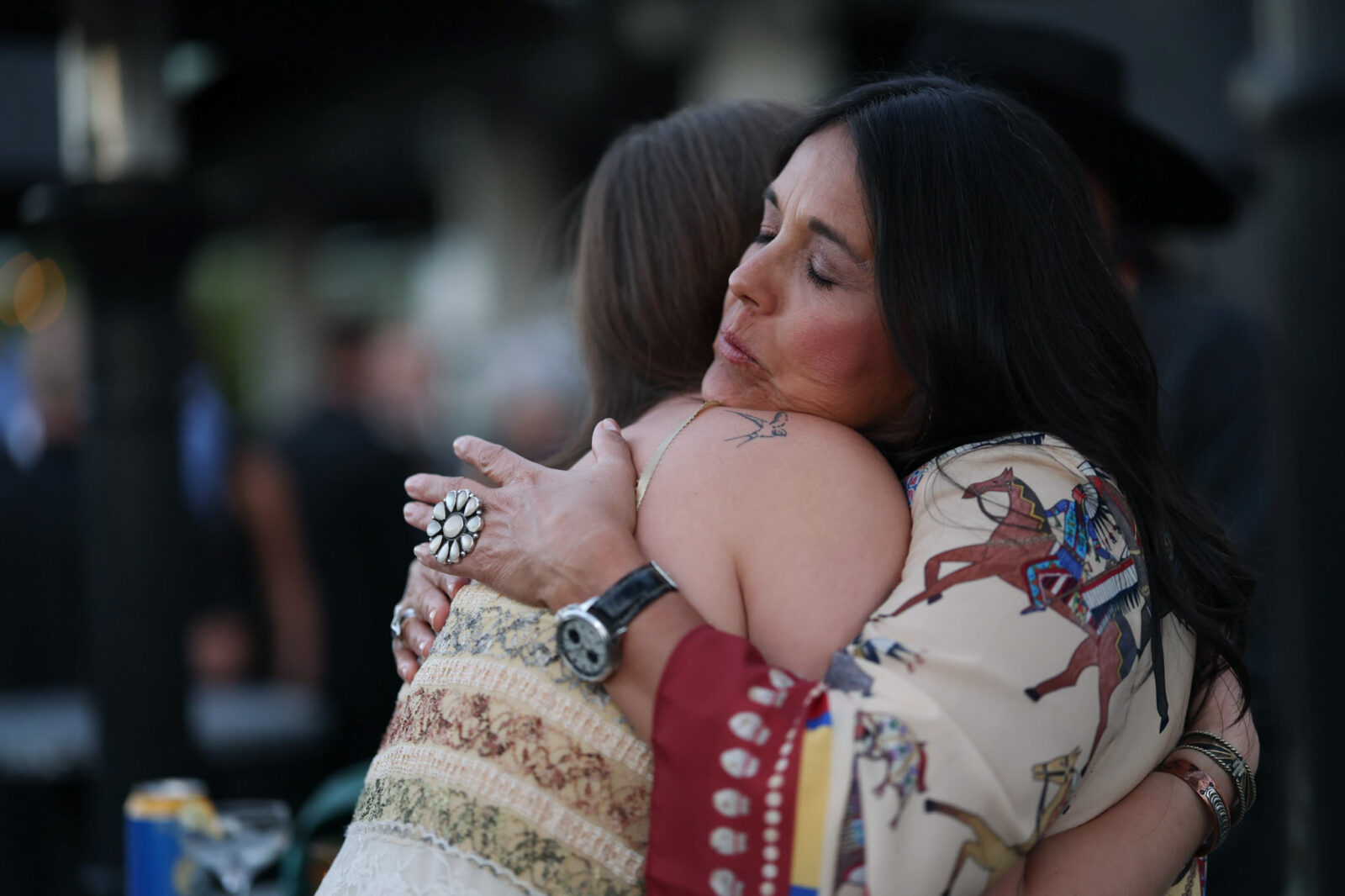
Much like most Tribal affairs, this project was a family affair—connecting the journey from page to screen, to the orange carpet, and culminating in an evening of revelry.
Aunties, uncles, nieces, nephews, distant cousins, siblings, children, friends, spouses, and all relations participated in the making, and every seat was filled.
Many drove over two hours from Temecula or San Diego—one-way—committed to supporting the project.
Just to name a few of the notable guests who walked the “orange” carpet (a signature of DWF’s defiant independence):
Chairman of the Pechanga Band of Luiseño Indians and current President of the National Congress of American Indians, Mark Macarro, was accompanied by his lovely wife, Holly Cook Macarro.
When asked what he thought of POTW, Chairman Macarro immediately said, “I am beyond proud! We’ve only scratched the surface. But it’s a beginning.”
Gene Brave Rock (Blood Tribe of Siksikaissksahkoi), and Ruth-Ann Thorn (Rincon Band of Payómkawichum) represented Native Hollywood in fine form.
Additionally, several attendees wore the internationally acclaimed fashion designs of Jamie Okuma (Luiseño, Shoshone-Bannock, Wailaki, and Okinawan), which fluttered with beauty as they walked by.
FIRST CONTACT
In conversation, Mr. Munoa cites different occasions when outdated and racist historical narratives were taught and experienced by his children in school (five were in attendance with his vivacious wife, Katie Munoa), which became the impetus for POTW.
For starters, there was a need to correct stereotypes and historical misinformation that were reenacted in schools about the Mission system and the Gold Rush.
Determined to create change, he took action.
It took almost 6.5 years. The first challenge was gaining the trust of tribal members. The second major challenge: shooting a union picture in California, which has a $1.5 billion film fund with rebates, but we didn’t qualify because we’re unscripted. Filming in California was essential. The land is as much a character as any actor. Despite hiring hundreds of actors and crew and contributing to the local economy, we received no recognition from the California Film Commission for our cultural or historical contributions. I was told that such a change requires legislation, which was very frustrating.
This was a deeply researched project that drew on oral histories, archives, and firsthand accounts.
Many California Indian scholars, educators, and tribal community leaders gave their invaluable time to record stories.
The main educators in First Contact were Cutcha Risling Baldy, PhD (Hupa/Yurok/Karuk) from Cal Poly Humboldt, Theresa L. Gregor, PhD (Iipay/Yaqui) from CSU Long Beach, and Stan Rodriguez, EdD (Kumeyaay) from CSUSM.
The atrocities of abductions, enslavement, and the violence experienced by California’s Original Peoples at the hands of the Spanish priests and conquistadors were sensitively reenacted, portrayed and filmed.
Characters mostly speak in English to reflect forced assimilation rather than cultural authenticity.
POTW is designed to highlight key moments in California’s history from pivotal Indigenous perspectives.
However, the series acknowledges that not all tribes or origin stories are included.
“Naming all 110 federally recognized California tribes in the project is impossible, given that there are over 50 federally unrecognized communities as well,” as explained by Mr. Munoa.
In fact, after 60 minutes, the closing credits were notably inclusive and respectful.
It included cast, crew, advisors, and historians for another eight minutes.
The high-quality production shines, with standout visual effects and hand-crafted animation.
Clear audio and a compelling soundtrack feature an original score by Jacob Yofee and Roahn Hyltonm for all ten episodes.
Singer and songwriter Alexis Munoa-Dyer (Payómkawichum) consulted, advised, and performed with the team.
The song at the end of First Contact—sung by Sarah Koyo (Chumash) in both Limuw (Santa Cruz Island) and šmuwič—was unforgettable and left me with a deep emotional longing.
ETHNIC STUDIES 101
Governor Gavin Newsom formally acknowledged California’s role in the genocide of its Native People in 2019.
A genocide sanctioned in 1850 by California’s first Governor Pete H. Burnett.
In 2021, California mandated a statewide Ethnic Studies graduation requirement (AB 101).
Mr. Munoa said, “While the state provided a model curriculum, they suggested educators reach out to local tribes for more information, materials, and resources specific to their history. Although in reality, both sides often lack the bandwidth and resources for such a massive undertaking.”
After 145 years, former President Joe Biden acknowledged in 2024 and formally apologized for the multi-generational trauma of the historical Indigenous genocide resulting from the federally mandated Indian boarding school system.
President Biden called the forced assimilation and abduction of Indigenous children “a sin on our soul” and “a blot on American history.”
Mr. Munoa shared one of his favorite feedbacks: “When we focus-tested Episode Six with a family in our tribe that descended from boarding school survivors forced to cut their long hair, the boys told their mom, ‘We want to grow our hair long again.’ That says it all.”
In response to these educational gaps, POTW is intended to serve as a resource for teachers and students.
A full 155 page curriculum was created to accompany the series.
Currently, it’s being adapted from the 9-12 grade curriculum (main priority) to an elementary grade level (age-appropriate) version in addition to the mainstream public viewing version.
Mr. Munoa stated that responses from educators have been positive:
Barona’s Middle School teacher, Kristal Hoffman, and the Director of the Barona Cultural Center and Museum, Laurie Egan-Hedley, have adapted our 155-page curriculum, which was created with expert Courtney B. Cook, PhD, to meet the state’s high standards.
Sweet Water High School in San Diego is interested in using it for their Ethnic Studies class. The Kumeyaay Community College is on board, and Southwestern College wants to use it for professional development, while SDSU, UCSD, and other universities, such as USC, are interested in screenings.
AND THAT’S A WRAP!
The after-party was as glamorous as the Hollywood sign anchored in the distant hills.
Alternating throw pillows with the colorful circular Pechanga logo and the black-and-white POTW logo adorned the rooftop couches of a former 1920s theater.
Later, it served as a recording studio, Grandmaster Recordings, and is now a private venue.
Guests were greeted by contemporary Pow Wow drumming, which segued into irresistible dance music spun by DJ Brian Frejo (Pawnee-Seminole).
The smudging of white sage wafted through the air, reminding guests that POTW was in the house.

Chef Keven Alan Lee created gourmet charcuterie platters featuring domestic and imported cheeses, cured and dried meats, seasonal fruits, fresh vegetables, dips, and an assortment of breads.
Top-shelf libations and signature cocktails, accompanied by delectable trays of Mini Street Elote, Porcini Mushroom Arancini, White Fish Ceviche Tostada, Chicken Egg Rolls, Prime Beef Knish, and Sticky Toffee Pudding with Bourbon Caramel, were served into twilight.
A few heads adorned with green “dad” caps inscribed with “You Are On Native Land,” and the POTW logo on the side were seen on the dance floor.
Indigenous-owned and Indigenous-operated Urban Native Era in collaboration with POTW provided the caps as mementos.
Black-and-white bandanas with POTW emblazoned were tucked into back pockets and tied around purse handles to advertise the show.
HOLLYWOOD – ON TONGVALAND
People of the West is an award-winner on many levels.
It stands out for excellent direction, writing, acting, casting, editing, and world-class cinematography.
Perhaps one day, someone from the POTW cast will join the too few Native American plaques on the Hollywood Walk of Fame:
Jay Silverheels (Mohawk), Chief Dan George (Tsleil-Waututh Nation), an Academy Award-nominated actor for Little Big Man, Wes Studi (Cherokee), and Graham Greene (Oneida).
There are no female Native American stars on Hollywood Boulevard.
Not yet.
Looking around the sea of humanity on this fine summer day, I realized something else was missing.
There are no Native American actors among the theater’s traditional handprints and footprints in its cement courtyard either.
Standing on Tongvaland, I ponder the semiquincentennial celebrations this country is preparing for and how it could begin with a set of Native footprints and handprints here.
The POTW episodes are as follows:
Episode 1: First Contact (world premiere)
Episode 2: Missions
Episode 3: Gold Rush
Episode 4: Genocide
Episode 5: Reservations
Episode 6: Boarding Schools
Episode 7: The American Dream
Episode 8: Red Power
Episode 9: Gaming
Episode 10: Future Generations
“Every story honors the broader truth: that California is, and has always been, Indian land.” —POTW
Community and educational screenings are coordinated through Picture Motion for educators interested in collaborative programming.
Inquiries can be sent to: peopleofthewest@picturemotion.com
Please visit: https://peopleofthewest.org/ for additional information.